
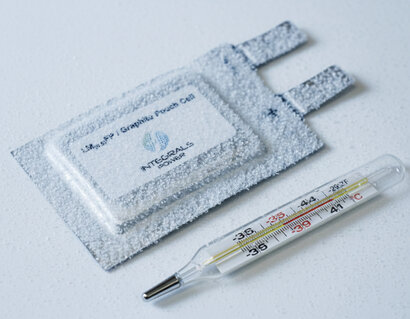
The on-going cycle life test programme, conducted by QinetiQ, has now achieved more than 1,500 charge and discharge cycles at a 1C rate, with the pouch cell retaining nearly 80 percent of its original capacity. The 1,000-cycle milestone was passed last year, at which point the retained capacity was more than 80 percent.
This level of durability is essential for Lithium-ion battery packs in applications that must deliver a long service life with little degradation to state-of-health over time, such as electric vehicles. This can contribute to higher residual values and reduced warranty and repair costs for vehicle manufacturers and suppliers, which in turn will help to boost consumer confidence in EVs and accelerate the transition to e-mobility.
Sub-zero testing carried out by Cranfield University addresses another key challenge: the ability to offer a high percentage of maximum capacity at very low ambient conditions. Without this, EVs, for example, offer limited range in winter, or military vehicles and drones operating in arctic conditions may have significantly reduced operation times. Cranfield’s results show that the pouch cell – manufactured in the same batch as the cells tested by QinetiQ – had 85 percent retained capacity at -25ºC and 68 percent at -30ºC. Current benchmark LFP and LMFP cell chemistries typically deliver only around 50 percent and 40 percent respectively, highlighting the value that Integrals Power’s LMFP material can bring to applications across a range of sectors with very demanding performance requirements, including automotive, maritime, aerospace, and defence.
In addition to durability and performance, it offers lower cost, higher safety, less toxicity, less reliance on critical minerals, and lower carbon footprint than the Nickel Manganese Cobalt (NMC) cell chemistries currently favoured by global vehicle manufacturers for EV batteries. It also has significantly greater energy density than LFP, which is taking a growing share of the battery market. These attributes, together with these latest test results, further demonstrate why Integrals Power’s LMFP material represents a real technology breakthrough.
“Independent, third-party testing by industry experts is a cornerstone of our business, and these latest results from QinetiQ and the University of Cranfield are invaluable in providing trusted and credible data to our customers around the world” said Integrals Power Founder and CEO, Behnam Hormozi. “The results prove that batteries made from our LMFP material can last longer and perform better in sub-zero conditions. Overcoming the compromises and limitations imposed by existing cell chemistries is essential if battery power is to realise its full potential across a range of sectors, and we’re showing that it can do exactly that.”
Integrals Power produced the LMFP used in the tests at its UK pilot plant, from raw materials sourced from Europe and North America. This demonstrates not only that this next-generation cell chemistry can help overcome the global automotive industry’s reliance on China, but also that the secure, transparent sovereign supply chains needed to meet growing demand for batteries within the defence sector can be established.
In addition to the international patents it holds on LMFP, Integrals Power has also patented a number of innovations for over 20 cathode materials including LFP, highlighting that far from being a commodity product, this cell chemistry still holds considerable development potential in applications where cost and safety are the most important attributes.
For additional information: