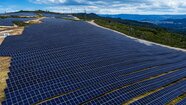

Electricity systems worldwide are benefiting from a greater integration of wind and solar power than ever before. This shift is great for sustainability, but these resources are also unreliable and inconsistent, which means energy supply fluctuates throughout the day. At the same time, buildings are adopting rooftop solar, battery systems, EV chargers, advanced HVAC controls and sensors.
With all these pieces working together, buildings can operate entirely on clean and smart energy use. This can shift demand, store energy when it's abundant and release it when the grid needs support, allowing for more flexibility in the otherwise unpredictable power.
Building owners can harness this flexibility by reducing peak demand charges, optimizing their use of solar energy, and, in some regions, even earning money by participating in grid programs. Experts predict that by 2028, as much as 96% of all green energy will be generated from solar power.
A smart building manages energy storage through layers of sensing, forecasting and control. The idea requires simple steps — gather accurate data, process it in real time and use it to make good decisions. Here’s what typically goes on behind the scenes:
Meters track electricity use, solar production, battery charge levels and sometimes even occupancy. This enables the system to respond quickly, rather than relying on guesswork.
Modern Building Energy Management Systems coordinate HVAC, lighting, EV chargers and the battery. They decide when to charge or discharge the battery and when to shift loads within the building.
Short-term forecasts predict solar output, building load and utility prices. These predictions enable the system to plan ahead rather than react at the last second.
The system follows rules set by the building operator, such as maintaining a certain amount of battery reserve for reliability, avoiding excessive battery cycling and ensuring strict indoor comfort levels.
In some regions, buildings receive price signals or direct requests from the utility or grid operator. They may also be part of a virtual power plant (VPP) that aggregates many buildings into one flexible resource.
Several strategies consistently deliver strong results. These are the approaches most commonly used in successful projects.
Many commercial buildings pay costly demand charges based on their highest usage spikes. Batteries can discharge during these peaks, flattening the load curve and significantly reducing monthly bills.
Solar energy is most abundant midday, but most buildings need more electricity in the late afternoon and early evening. Storage bridges this gap by absorbing excess midday solar and releasing it later.
In areas with suitable programs, buildings can respond to grid events by reducing load or injecting stored energy. Batteries react quickly, which makes them valuable for frequency regulation and other fast-response services.
Even if a building’s main goal is cost savings, many operators maintain a reserve in case of outages. This hybrid approach makes storage more attractive overall.
HVAC systems are usually the biggest load in a building. Smart pre-cooling or pre-heating allows the building to reduce HVAC demand during times when the grid is stressed, without sacrificing comfort.
When many buildings coordinate through a VPP, they can access incentive programs or grid markets that would be out of reach individually. This is where small distributed batteries start acting like utility-scale assets.
As cities worldwide continue to grow denser and more complex, exceptional plumbing services that can address damaging leaks as well as integrate water-saving and eco-friendly practices are as essential as advanced energy systems. The hidden infrastructure behind walls and floors must keep pace with rapid urban expansion just as much as the electrical and mechanical systems do.
Reliable plumbing networks ensure that water use, waste management and pressure regulation remain stable even as building loads increase — and in a high-performance structure, those basic systems must work seamlessly with the building’s ventilation, energy controls and sustainability features to maintain overall efficiency.
Here are a few real-world examples of buildings where energy storage, smart building design and microgrids have been used to improve resilience, efficiency and grid flexibility.
The Tower at PNC Plaza
The Tower at PNC Plaza in Pittsburgh, headquarters of PNC Financial Services Group, is often described as one of the greenest office skyscrapers in the United States. Although it’s not a microgrid in the same sense as campus- or community-scale projects, it demonstrates how innovative building design and integrated systems can significantly reduce energy demand.
The tower achieves this through a combination of active and passive design strategies. A double-skin facade provides insulation while enabling natural ventilation for much of the year. During favorable seasons, exterior vents draw in fresh air, and a solar chimney located in the building core creates airflow to exhaust heat, allowing the structure to “breathe” without the need for mechanical HVAC.
While the Hornsdale Power Reserve in South Australia is far bigger than any building installation, it demonstrates a principle that applies everywhere — fast response is incredibly valuable. It was originally a 100-MW system and later expanded to 150 MW. It proved that batteries can respond to grid disturbances in fractions of a second, outperforming traditional power plants in frequency control.
The University of California, San Diego campus operates one of the world's most advanced campus-scale microgrids. The microgrid combines multiple sources, including solar photovoltaic arrays, a natural-gas cogeneration plant, a fuel cell and a major battery energy storage system.
In 2015, the campus added a 2.5 megawatt/5 megawatt-hour battery storage system. The battery uses lithium-iron-phosphate chemistry, chosen for reliability and safety, and is integrated into the campus's energy mix.
This addition allows the campus to store energy generated during off-peak periods or from solar and fuel-cell generation and then deploy it during peak demand or when renewable output is low. The storage system enhances the campus's resilience, which is critical for UC San Diego. The campus hosts research labs and sensitive instruments such as electron microscopes, which would be severely disrupted by a blackout. These combined systems help the university supply 92% of the campus's annual energy needs.
As buildings adopt smarter controls and storage, they collectively become a major source of grid flexibility. Buildings are already integrating renewable energy, reducing strain during peak hours and improving energy reliability. As more of them join the digital grid, the system becomes cleaner, more stable and more cost-efficient for everyone.