
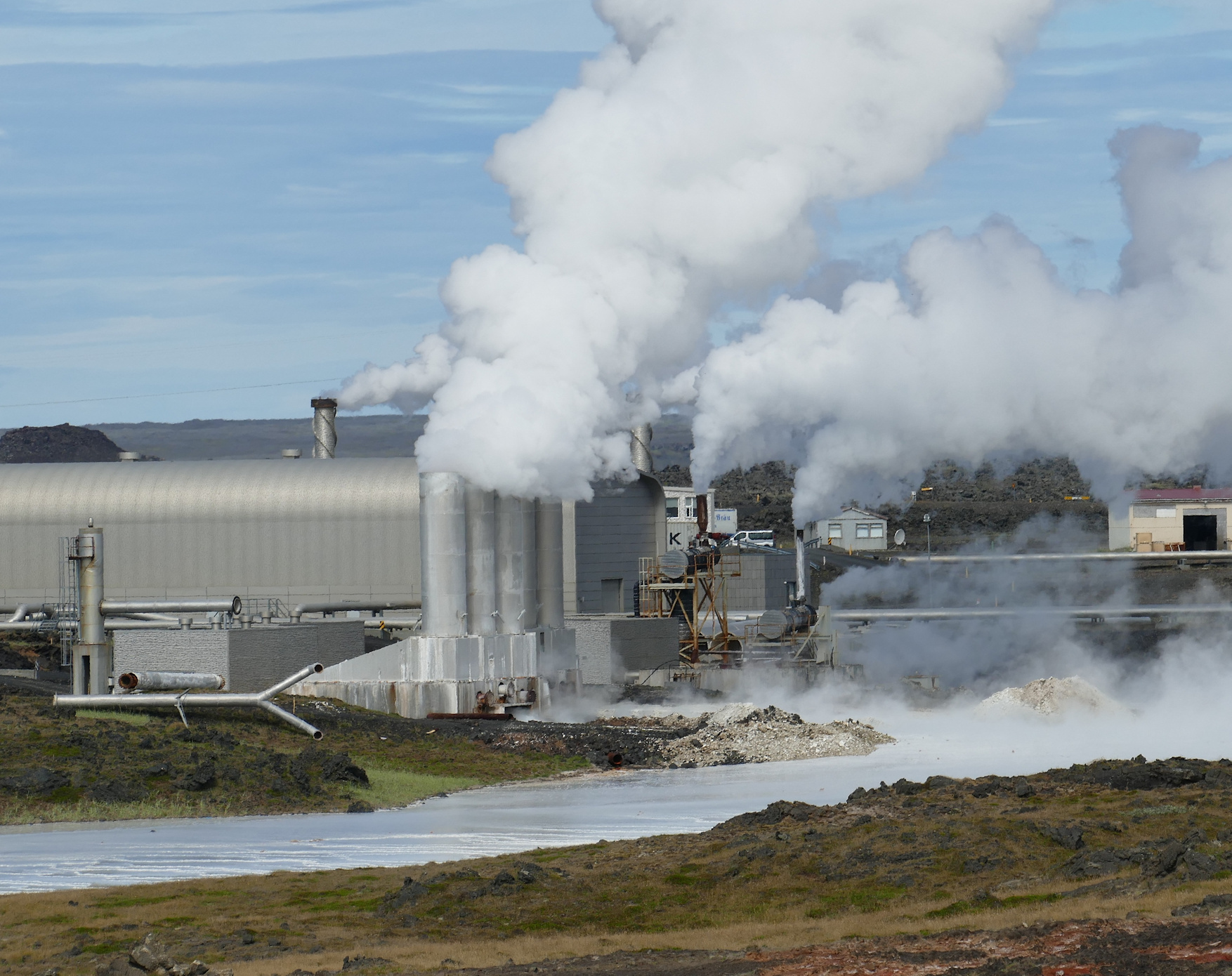
The demand for geothermal energy has been growing in Iceland and globally because geothermal energy is a clean, renewable energy source. Recent measures have been implemented to promote the development and production of geothermal energy.
Geothermal heat consumption in Iceland
Iceland’s power industry is mainly hydroelectric power plants with a total installed capacity of 2,104 MW which accounts for 70.6% followed by geothermal power plants which accounts for 25.5% of Iceland’s total generating capacity (Butuzov, 2023). All of Iceland’s hydroelectric power plants work together with geothermal power plants. Eight geothermal power plants have operated in Iceland since the year 2021 with a total installed energy capacity of 752.6 MW and electric power generation of 6,208 GH per hour.
The geothermal power plants are located on the north part of Iceland on geothermal deposits consisting of dry steam, steam-water mixture, and high temperature water. They are also located on the southern part.
The geothermal heat consumption in Iceland in 2021 was 9.340 GWh of which 71% was used for heating, followed by heating swimming pools, fishing, melting snow, industrial uses, and for heat pumps (Butuzov, 2023). The use of geothermal energy for fishing includes drying of fish products and for aquaculture (Ragnarsson, 2023).
Geothermal energy has become the primary source of space heating in Iceland since 1971, accounting for 91.5% of energy sources in the year 2021. From 1971 to 2021, the use of oil for space heating has declined to 0.3% while the use of geothermal energy in Iceland has been growing. In 2021, the nine major geothermal power plants produced a combined total of 5,788 GWh per year which was up from roughly 1,400 GWh per year in the year 2000 (Ragnarsson, 2023).
Global geothermal energy demand
Geothermal energy is a clean energy and the demand for it is growing globally. Geothermal power generation has increased globally in 43 years from 1980 to 2023, from 13,100 GW h to 96,552 GW h in 2023 - which is a 7.3 times growth. Geothermal energy is also the largest source of clean energy in several countries including Kenya, El Salvador, New Zealand and Costa Rica. The United States is among the top ten countries for the highest geothermal installed capacity in 2020-2021, approximately 3,800 MW followed by Indonesia (approximately 2,300 MW) and Philippines (approximately1,900 MW) (Gutierrez-Negrin, 2024).
The demand for geothermal energy due to regulations
Regulations passed in recent years by the International Energy Agency, the Net Zero Industry Act, and the European Critical Raw Material Act directly or indirectly support the production of geothermal energy. The overall aim of two of these legislations is to achieve net zero and for the other, to support the use of raw materials, one which is a by-product of geothermal energy extraction.
International Energy Agency (IEA)
In 2023, the International Energy Agency (IEA) held a meeting and released the Versailles statement (IEA, 2023) signed by 45 countries. This statement included the need to support stronger policies and actions to achieve net zero by 2050. To do this, the statement included accelerating the clean energy transition to reduce greenhouse gas emission.
The IEA in its 2024 report on the future of geothermal energy stated that “with continued technology improvement and reductions in project costs, geothermal could meet up to 15% of global electricity demand growth by 2050.” It also explained that this means deploying as much as 80 GW of geothermal power worldwide capacity to produce almost 6,000 terawatt-hours per year which is the equivalent of the current electricity demand in the United States and India combined.
This report also mentioned geothermal energy as a clean, versatile and secure energy source. It reported that the global geothermal capacity had an average utilization rate of 75% in 2023 compared to less than 30% for wind energy and 15% for solar photovoltaic. Additionally due to innovations in drilling technologies, it is now possible to drill at greater depths and capture more geothermal energy. The report also mentioned that drilling at depths below 4.9 miles (8 km) can deliver almost 600 TW of geothermal energy for 25 years (IEA, 2024).
The Net Zero Industry Act (NZIA)
Geothermal energy is one of the eight strategic net zero technologies listed in the Net Zero Industry Act (NZIA) (European Commission, 2024), effective since 2024, which provides a regulatory framework to achieve industrial decarbonization in Europe. The NZIA includes machinery, components, and final products needed to manufacture these technologies.
The European Critical Raw Material Act
Another Act, the European Critical Raw Material Act, regulates lithium — a rare earth metal and a by-product from geothermal energy extraction (European Commission, 2023). This Act has set a benchmark for critical raw materials that include lithium. The Act states that by the year 2030, at least 10% of the raw materials should be extracted, 40% processed, and 25% recycled. This indirectly calls for the demand for geothermal energy production because when geothermal energy is extracted, lithium is also extracted as a by-product. And the European Critical Raw Material Act requires at least 10% of lithium supply for extraction which is possible by extracting geothermal energy.
The demand for geothermal energy is high as is the complex processes involved in extracting the geothermal energy for electricity generation. These complex processes will be discussed in the next series.
References
Butuzov, V. A. (2023) Experience of the development of geothermal energy on the example of Iceland. Thermal Engineering, 70(9), 701-710. https://doi.org/10.1134/S004060152309001X
European Commission (2023) Critical Raw Materials: ensuring secure and sustainable supply chains for EU's green and digital future https://ec.europa.eu/commission/presscorner/detail/en/ip_23_1661
European Commission (2024) Net Zero Industry Act https://commission.europa.eu/topics/competitiveness/green-deal-industrial-plan/net-zero-industry-act_en
Guttierrez-Negrin, L.C.A. (2024) Evolution of world-wide geothermal power 2020-2023. Geothermal Energy, 12: 14 https://doi.org/10.1186/s40517-024-00290-w
IEA (2023) Versailles statement: the crucial decade for energy efficiency. https://www.iea.org/reports/the-future-of-geothermal-energy/executive-summary
IEA (2024) The future of geothermal energy.
https://www.iea.org/news/versailles-statement-the-crucial-decade-for-energy-efficiency
Ragrarsson, A., Steingrimsson, B., & Thorhallsson, S. (2023) Geothermal development in Iceland 2020-2023. Proceedings World Geothermal Congress 2023. Beijing, China September 15-17 2023.