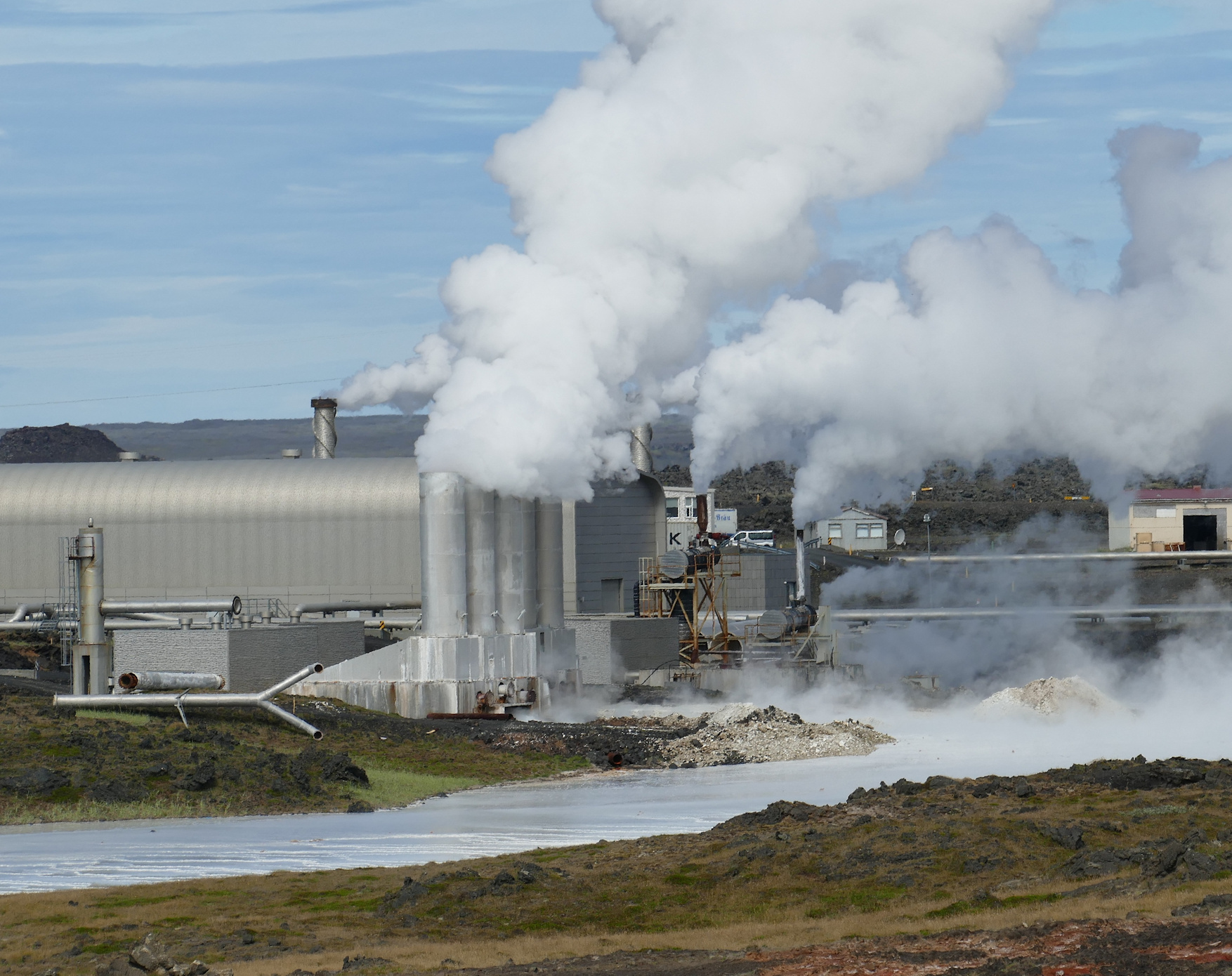
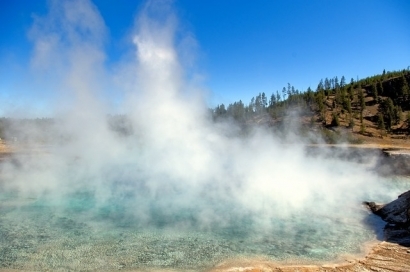
Despite the name, they are not real geysers but fumeroles, or steam vents.
The Geysers are adjacent to the Quaternary Clear Lake Volcanic Field, a picturesque area in the northwest area of California. Covering 45 square miles, The Geysers is the world's largest geothermal power plant complex that harnesses steam (or vapors) to generate 725 megawatts of electricity. This is enough to power a city the size of San Francisco.
How is geothermal energy extracted?
In volcanic areas like The Geysers, magma is typically located a minimum of four miles beneath the Earth's surface. Heat from the magma radiates into the rocks, causing the water in the pores and fractures of the rocks to become steam trapped below the Caprock.
Steel pipelines are used at The Geysers to capture the steam that goes to the thermal power plant. Inside this plant are turbines. Entering the turbines at a high pressure of 40 to 100 psig, the steam causes the movement of the turbine and this movement converts the thermal energy from the steam into mechanical energy.
Next to the turbine is a generator that transforms mechanical energy into electrical energy. There is also a cooling tower in the power plant where steam condenses into water that flows back into the ground.
It was not always like this at The Geysers – prior to 1990s, steam was directly tapped into the pipelines without the use of water. The Geysers field produced a total of 2,398 billion kg of steam from 1960 to 2008, the equivalent of 278 million MWh of electricity using a steam usage factor of 2.4 kg/s per MW.
Due to the fact more steam was captured than replaced in the 1970s and 1980s, water was injected at high pressure to capture the heat. The natural fractures in the rocks were opened wider by the high-pressure water to free the trapped steam, enabling it to flow into the geothermal plants.
While some of the condensed water is reinjected back into the ground, there are also pipelines that deliver treated water into the geothermal reservoir to uphold the reservoir pressure and steam production at The Geysers. Specifically, two pipelines, each over 40 miles long, deliver 20 million gallons of secondary and tertiary treated wastewater from Lake County and Santa Rosa into The Geysers.
What are enhanced geothermal systems?
From The Geysers, roughly 5,600 miles away and across the Atlantic Ocean, is Soultz, France, home to some of the deepest geothermal energy wells in the world. The most renowned is the Soultz-sous-Forets Enhanced Geothermal System or simply Soultz EGS located in the Upper Rhine Graben in France.
Some literature on geothermal systems, including for Soultz use the terminology “enhanced geothermal systems” or EGS. This means the use of fluids to extract the geothermal energy and it is the standard.
The fluid utilized in EGS is under high pressure in the injection well to reopen existing fractures or to create new rock fractures. This releases the trapped steam into the production well leading to the geothermal power plant.
Types of EGSs
There are two types of EGSs, according to the US Department of Energy: superhot and closed loop geothermal systems, both differing in whether the injection and the production wells are connected, or in other words, on their reliance on natural fractures.
In the first, the injected fluid from the production well untraps the steam from the natural fracture that then travels in the production well. The two wells are unconnected unlike in the closed loop geothermal systems where the injected fluid heats to provide the steam that is collected via the production well. Akin to a radiator, the injected fluid (also known as the working fluid) absorbs the heat and this heat is harnessed when the hot fluid travels up the production well.
Drilling distance
The distance drilled in the crust to harness geothermal energy varies depending on the geothermal reservoir – it could be from 2,402 to over 10,000 feet. In 1972, a well was drilled at a depth of 2,402 at a Fenton Hill site in New Mexico in the US. More than two decades later, in 1985, one of the drilled wells at Sandia National Laboratories had a depth of 7,471 – a depth of three-fold more than the Fenton Hill’s well depth.
Although it might sound like the well depth has been increasing over the years to extract geothermal energy, that is not the trend from the data. Although the depth of the well is generally proportional to the well cost, wells can have different depths depending on the ownership, the location drilled, and on financial affordability.
Drilling depths have been reported in the range of 14,000 feet to 16,000 feet for using EGSs (Lukawski et al, 2014). The reinjection well, GPK-3, at Soutlz, France was reportedly 16,731 feet deep as of 2003.
Looking ahead
Although The Geysers generate enough electricity to supply cities, their location is also prone to frequent earthquakes. The latest was 1.3 duration magnitude, 1.9 miles NNW of The Geysers on May 5, 2026 reported by the USGS. While many such earthquakes are frequent near The Geyser, the nearby locations also experience significant earthquakes. One example, also reported by the USGS is the 4.3 duration magnitude earthquake, only 0.6 miles ESE of The Geysers on September 7, 2024.
In addition to earthquakes, the Soultz EGS also faces issues with noise and radioactive pollution. The expansion of gas in the turbine and the fan rotation in the air-cooling system causes noise pollution. With the wells sitting over granite, a naturally occurring chemical that contains radioactive isotopes, the geothermal energy harnessing operation potentially exposes workers to radiation.
In October 2011, the GPK-2 platform recorded an average ambient radioactive dose rate of 0.45 µSv/h with the contact value of 2 µSv/h and the highest value of 10 µSv/h (Albert et al, 2012). Micro-Sievert per hour (µSv/h), the dose rate, is the dose of radiation received by a body per unit of time. The contact dose rate was not significantly lower one and half years later where the average value was 1.74 µSv/h. The legal limit is 1 µSv/h.
What causes the nearby, frequent earthquakes at The Geysers? What is the origin of the radiation at the Soultz ESG? These will be discussed in the next installment on the challenges associated with the extraction of geothermal energy – a natural energy source, yet complex to harness.
References
Albert, G., Nicolas, C., Xavier, G., Berndt, M., Bernard, S., & Julia, S. (2012) Status of the Soultz geothermal project during exploitation between 2010 and 2012, Proceedings, 37th Workshop on Geothermal Reservoir Engineering, Stanford University, Stanford, California, January 30-February 1, 20212. SGP-TR-194.
Augustine, C., Tester, J. W., & Anderson, B. (2006) A comparison of geothermal with oil and gas well drilling costs. Stanford School of Earth, Energy & Environmental Sciences.
Avakian, B., Hebert, R., & Ledesert, B. (2024). Faults in enhanced geothermal systems: Soultz-sous-Ferets site and its analogue in the Upper Rhine Graben. European Association of Geoscientists & Engineers. EAGE Workshop on Naturally Fractured Rocks (NFR), October 2024, 2024: 1-3. https://doi.org/10.3997/2214-4609.2024637052
Ball, J.L., Burgess, S., and Blatter, D., 2025, Young explosive eruptions from the Clear Lake volcanic field: U.S. Geological Survey Fact Sheet 2025–3020, 6 p., https://doi.org/10.3133/fs20253020.
Baumgartner, J., Gerard, A., & Baria, R. (1999) Sultz-sous-Forest: main technical aspects of deepening the well GPK2. European Geothermal Conference Basel ’99, September 28-30, 1999, Volume 2, Basel, Switzerland Proceedings. https://pangea.stanford.edu/ERE/pdf/IGAstandard/EGC/1999/Baumgartner.pdf
California Energy Commission (2022) Investigating flexible generation capabilities at the Geysers. Final project report. CEC-500-2022-005. https://www.energy.ca.gov/sites/default/files/2022-09/CEC-500-2022-005.pdf
Cuenot, N., Scheiber, J., Moeckes, W., & Genter, A. (2015) Evolution of the Natural Radioactivity on the Soultz-sous-Forêt EGS Power Plant and Implication for Radiation Protection. Proceedings World geothermal Congress 2015, Melbourne, Australia, 19-25 April 2015. https://pangea.stanford.edu/ERE/db/WGC/papers/WGC/2015/02027.pdf
Deyazes, C., Genter, A., Homeier, G., Degouy, M., & Stein, G. (2003) Geological study of GPK3 HFR borehole (Soutl-sous-Forets, France) Report # BRGM/RP-52311-FR. https://infoterre.brgm.fr/rapports/RP-52311-FR.pdf
Goyal, K. P., & Conant, T. T. (2010) Performance history of The Geysers steam field, California, USA. Geothermics, 39(4): 321-328.
https://pangea.stanford.edu/ERE/pdf/IGAstandard/SGW/2006/augustin.pdf
Journal of Petroleum Science and Engineering,118: 1-14. https://doi.org/10.1016/j.petrol.2014.03.012.
Kabeyi, M. J. B., & Olanrewaju, O. A. (2023) Geothermal energy resources, exploitations and applications. Proceedings of the Second Australian International Conference on Industrial Engineering and Operations Management, Melbourne, Australia, November 14-16, 2023. https://www.researchgate.net/profile/Dr-Kabeyi/publication/378799759_Geothermal_Energy_Resources_Exploitations_and_Applications/links/6690e75b3e0edb1e0fdd6ea0/Geothermal-Energy-Resources-Exploitations-and-Applications.pdf
Loni, R., Mahian, O., Najafi, G., Sahin, A. Z., Rajaee, F., Kasaeian, A., Mehrpooya, M., Bellos, E., & le Roux, W. G. (2021) A critical review of power generation using geothermal-driven organic Rankine cycle, Thermal Science and Engineering Progress, 25, 101028. https://doi.org/10.1016/j.tsep.2021.101028
Lukawski, M. Z., Anderson, B. J., Augustine, C., Capuano, L. E., Beckers, K. F., Livesay, B., & Tester, J. W. (2014) Cost analysis of oil, gas, and geothermal well drilling,
Mitchell, M. A., Peacock, J. R., & Burgess, S. D. (2023) Imaging the magmatic plumbing of the Clear lake Volcanic Field using 3-D gravity inversions. Journal of Volcanology and Geothermal Research, 435, 107758. https://doi.org/10.1016/j.jvolgeores.2023.107758
NASA (2022) The Geysers of California. https://science.nasa.gov/earth/earth-observatory/the-geysers-of-california-150297/
The Global Economy – Electricity production capacity – Country rankings. https://www.theglobaleconomy.com/rankings/electricity_production_capacity/
USGS Earthquake Hazards Program. M1.3 – 3 km NNW of The Geysers, CA. Last accessed May 5, 2026. https://earthquake.usgs.gov/earthquakes/eventpage/nc75357382/executive
USGS Earthquake Hazards Program. M4.3– 1 km ESE of The Geysers, CA. Last accessed May 5, 2026. https://earthquake.usgs.gov/earthquakes/eventpage/nc75058606/executive
USGS Frequently asked questions – Natural hazards. Why are there so many earthquakes in the Geysers area in Northern California? Last accessed May 5, 2026. https://www.usgs.gov/faqs/why-are-there-so-many-earthquakes-geysers-area-northern-california