

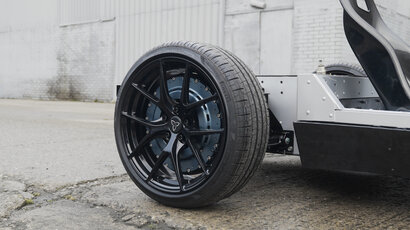
The two companies will show a functional prototype skateboard platform at CES 2026 in Las Vegas on the Donut Lab stand.
The collaboration centres on Watt’s PACES (Passenger And Commercial EV Skateboard), a low-volume aluminium platform technology featuring lightweight construction. PACES will now incorporate Donut Lab's in-wheel motor technology, featuring two direct-drive motors at the rear axle, with a four-wheel drive variation coming later in 2026.
The result is an exceptionally lightweight EV platform focused on performance and agility, capable of spawning multiple vehicle configurations from beach buggies to high-performance sports cars to commercial delivery vehicles. This modular approach dramatically lowers the barrier to entry for new vehicle development while maintaining the highest standards of performance and efficiency.
At the heart of this partnership's innovation is the ability to independently control each Donut Lab in-wheel motor with millisecond precision. This greatly improves torque vectoring during cornering on tarmac or when finding grip off-road.
By eliminating traditional powertrains entirely, the direct-drive architecture removes unnecessary weight, frees up package space and reduces complexity while dramatically improving energy transfer efficiency. The system's real-time control capabilities greatly improve accuracy, stability, and traction control.
“The integration of Donut Lab's revolutionary in-wheel motor technology represents a significant leap for what PACES can offer the automotive world” said Neil Yates, CEO of Watt Electric Vehicles. “Its motors, inverter, and software systems, perfectly complement our lightweight platform philosophy. The direct, fine control of the individual wheel speeds brings an agility and that is perfectly complemented by the low mass and inertia of our chassis technology. This skateboard can produce vehicles that will set new benchmarks for EV handling.”
The Watt-Donut Lab skateboard platform's modular nature opens doors to an extensive range of vehicle types and applications across multiple segments. The simplified architecture also reduces manufacturing complexity, minimises lifetime maintenance requirements, and lowers overall costs compared to traditional electric powertrains, making high-performance electric vehicles more accessible to smaller manufacturers and niche markets.
For additional information: