
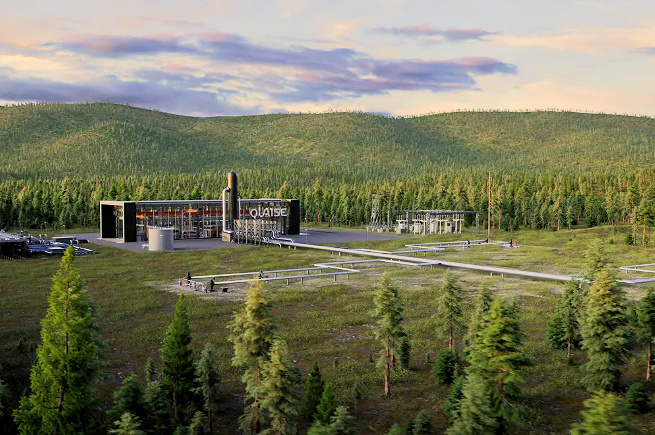
A Quaise analysis presented at the 2026 Stanford Geothermal Workshop validates the company’s belief that its first plant could produce at least 50 megawatts of clean, renewable electricity. That energy, produced from only a handful of wells, would be available 24/7.
Subsequent expansions of Project Obsidian at the same location are expected to bring even more energy. The second phase targets 250 MW.
“Our goal is to build out to a gigawatt in the area,” says Carlos Araque, CEO and co-founder of Quaise.
He continued, "We believe our breakthrough drilling technology could ultimately make gigawatt-scale geothermal plants viable across the globe, including in regions where geothermal has never been possible before."
Because Project Obsidian is the first of its kind, there are many unknowns, such as the geochemistry of the rock it will tap into. Daniel W. Dichter, a senior mechanical engineer at Quaise, is first author of a paper exploring these unknowns that he presented at Stanford earlier this year. Dichter has also presented other papers related to designing superhot power plants.
“Most of our analysis, which is based on several models, was dedicated to trying to understand some of these uncertainties,” says Dichter. Quaise also supports research at Oregon State University aimed at doing the same thing by recreating extreme underground conditions in the lab.
Dichter’s overall conclusion, “This analysis validates our long-held hypothesis that higher subsurface temperatures entail substantial improvements in power production. It shows us that we can get to a capacity of 50 megawatts of power with this system.”
He continues, “If these first wells work the way we think they will, they will be on par with exceptionally productive oil and gas wells in terms of equivalent power output.”
Project Obsidian
The first phase of Project Obsidian will consist of two separate geothermal well systems. One will target rock at temperatures reaching as high as 365 degrees Celsius (689 degrees F) with an average temperature of 315 degrees C. The other will target rock at temperatures as high as 415 degrees (779 degrees F) with an average temperature of 365 degrees C.
Why build two systems targeting different temperatures? The one targeting an average of 315 degrees C, says Dichter, “is on the cusp of what is achievable today, so it’s lower technical risk. With what we learn from that system, we’ll go to the hotter one, which is riskier.”
That follows the Quaise blueprint for developing superhot, superdeep geothermal energy worldwide. The blueprint involves three phases, or tiers, based on geothermal gradients, or how close the resource is to the surface.
Project Obsidian is a Tier I location, able to access superhot temperatures at about five kilometers (about three miles) beneath the surface. Dichter notes that the first wells at Project Obsidian will be drilled conventionally, without millimeter wave energy.
That, too, is part of the Quaise blueprint, which involves a hybrid approach to drilling. Conventional drilling technologies will remove rock near the surface (what they were optimized for), followed by millimeter waves for powering through the basement rock below. Millimeter waves won’t be used “until the 365°C wells at the earliest,” Dichter says.
Small Footprint
The two well systems that comprise the first phase of Project Obsidian will have a surface footprint of 20 acres. That underscores a key advantage of geothermal systems, which use less than three percent of the land required for similar solar- and wind-energy sites, according to the University of Texas at Austin.
Each of the two well systems, in turn, comprises three wells. Water will be pumped down one of these to the hot rock. The two wells on either side will capture the hot water that results from flowing through the hot rock. Contributing to the project’s small footprint: the pipes conveying water to and from the SHR formation have a maximum inner diameter of only about ten inches.
The first phase of Project Obsidian will also have a seventh, or confirmation, well. This one—the first to be drilled— will give the Quaise team key information on variables including the geomechanical, or physical, properties of the superhot rock. These data will dictate, for example, how the team fractures rock at depth to create pathways for water to flow.
The confirmation well is expected to be in operation later this year.
Author: Elizabeth A. Thomson Correspondent