
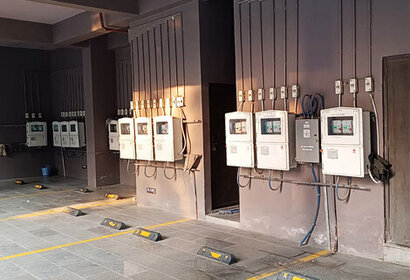
Wirepas’ mesh technology connects some of the largest smart metering networks on the planet, including deployments with more than a million smart electricity meters in a single network. These implementations deliver 99.99 percent reliability across vast geographies from dense urban high-rises to remote rural villages, including extreme environmental conditions. New meters efficiently join every few seconds, continuously expanding the reach and resilience of the Wirepas networks – and reducing the workforce effort massively which is advantageous given the shortfall of qualified engineers in this field.
“Reliability at scale isn’t theory for us, it’s a responsibility we take seriously” said Teppo Hemiä, CEO of Wirepas. “India is the toughest testbed imaginable for IoT. It is dense, diverse and dynamic. If your radio network performs there, it performs anywhere. That’s why our experience in India is the strongest proof point for Europe’s energy future. Europe, on the other hand, sets the highest benchmark for compliance and trust. Meeting Europe’s stringent standards for connectivity, interoperability and data protection underlines the maturity and robustness of our technology.”
Unlike centralized cellular or PLC systems, every meter in a Wirepas RF mesh acts as both transmitter and receiver, creating a self-healing, decentralised network that continues to operate even when individual connections fail. This in turn enables uninterrupted large-scale data flow without costly infrastructure or single points of failure.
Europe is undergoing a historic transformation in its energy systems, driven by electrification. By 2029, the continent is expected to reach 80 percent smart meter coverage (285 million devices), with the European Commission projecting 580 billion euros in grid investments by 2030, 170 billion of that in digitalisation.
However, many of Europe’s existing networks still rely on legacy PLC or cellular communications, technologies not designed for current scale, reliability and affordability requirements.
As utilities prepare to integrate millions more connected devices, resilient, self-healing RF mesh networks are emerging as the critical missing layer.
“As Europe accelerates electrification and decentralisation in parallel, one essential layer has often been underestimated: the choice of connectivity determines if digitalised grid can be sustained with less investment in copper” added Mr Hemiä. “The energy transition depends on data as much as on electrons. Every meter and sensor must communicate seamlessly to balance demand, optimise supply and ensure grid stability – while at the same time delivering non-repudiable data as the basis for small-ticket financial transactions between asset owners, consumers and system operators. Decentralised energy systems require decentralised communication, and that’s exactly what NR+ and Wirepas deliver.”
Wirepas’ technology is built on NR+, the new global standard, created in Europe, for massive IoT that uses license-exempt spectrum instead of costly mobile licenses.
This architecture offers:
Together, these strengths directly address the Energy Trilemma: enhancing security, equity and sustainability.
Wirepas will present its latest technology and India success stories to OEMs and solution providers at Enlit Europe 2025 in Bilbao, Spain, 18–20 November 2025, at the ESMIG pavilion, stand no. 1.D40.
For additional information: