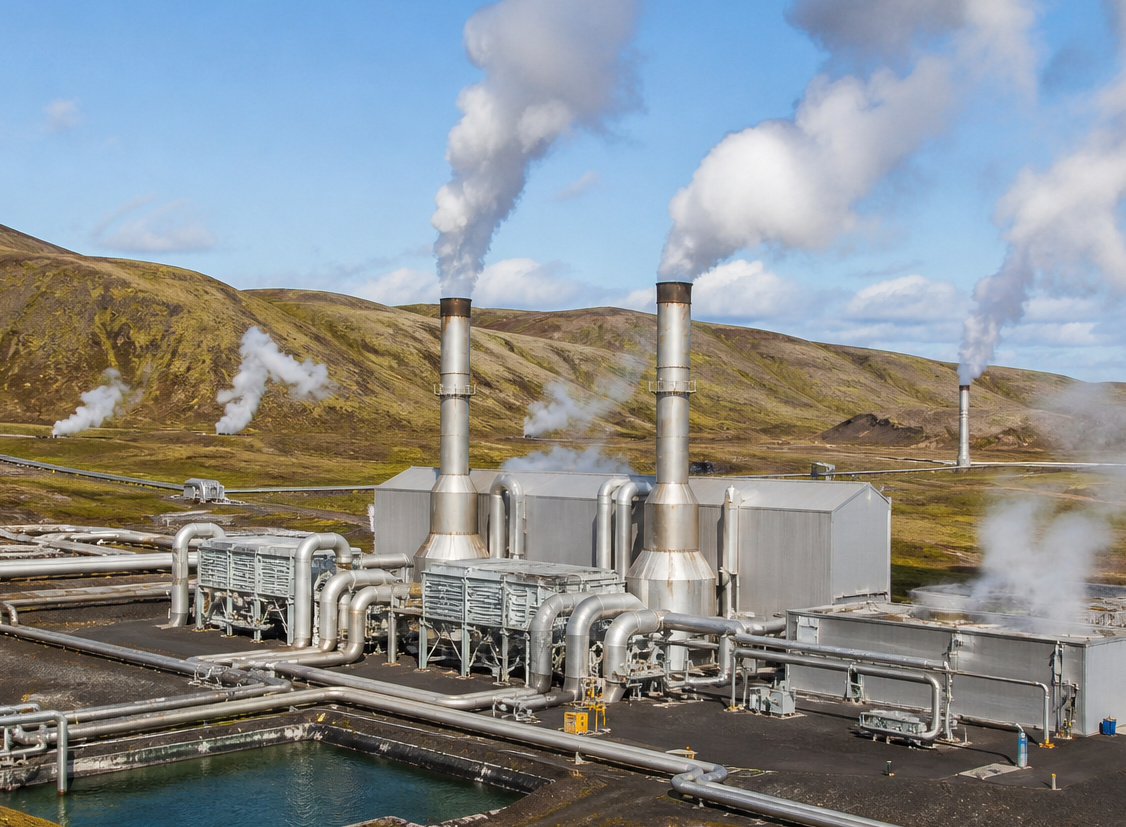

Globally, power production from geothermal energy has increased by 7.3 times in 43 years from 1980 to 2023 – from 13,100 GWh to 96,552 GWh in 2023 (Gutierrez-Negrin, 2024). Additionally, there is also demand for geothermal energy due to regulations implemented over the past few years– namely by the International Energy Agency, the
Net Zero Industry Act, and the European Critical Raw Material Act. Before we discuss these, let’s take a look at what is geothermal energy.
What is geothermal energy?
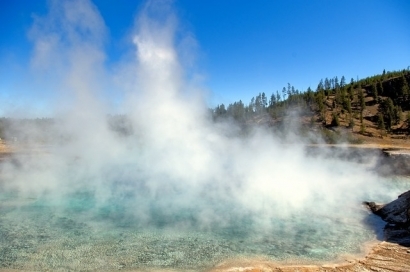
Geo means Earth in Greek. And thermos is Greek for thermal meaning heat. So geothermal energy is heat from the Earth. Technically, it is a renewable energy captured from the surface of the Earth. It is called renewable energy because geothermal power plants world-wide are still running even after 50 years. Also, the water used in drilling to extract geothermal energy can also be repumped back, allowing a continuous drilling cycle.
The source of geothermal energy from within the Earth’s surface Geothermal energy comes from the Earth’s interior which has four components – the inner core, the outer core, the mantle, and the crust. The inner core is basically made of iron and so it is hard, and it is about 1,500 miles wide. It is also very hot, about 10,800 o F, which is as hot as the sun’s surface.
Wrapped around the inner core is the outer core that has magma which is molten. Magma is also found in the mantle, which is the layer surrounding the outer core. Surrounding the mantle is the crust.
Rock and water are found in the crust and also in the mantle where they also absorb hear from the magma. The mantle has a temperature of 329 o F near the crust and 7,230 o F closer to the outer core.
The crust is broken into tectonic plates and magma can get close to the surface where these plates meet. The hot rocks – made molten because of the heat from the magma – when they erupt during a volcanic eruption, are the main composition in lava.
So the main source of the geothermal energy within the Earth is from the inner core. It radiates heat to the other layers, heating the rocks and the water.
Where are the sites of geothermal energy on Earth?
On the Earth’s surface, most of the major geothermal energy sites are found near the edge of the Earth’s major tectonic plates. Some of the most active geothermal energy sites are also found in what is called the Pacific Ring of Fire. It is a geographical area containing high volcanic and seismic activities within the edge of the Pacific Ocean (Roque et al., 2024).
What heats the Earth’s mantle?
There are three theories for how the Earth’s mantle is heated: by the decay of radioactive isotopes, by gravitational energy, and by frictional heat generated by the plumes inside the Earth.
The heat flux on the surface of the Earth, which is about 44TW, is mostly attributed to continual isotope decay of potassium-40, uranium-238, and thorium-232 in the mantle (Helffrich et al, 2021; Serafini, 2022). Isotopes are form of an element that have different number of neutrons than the normal element. For example, potassium has 20 neutrons
but potassium-40 has 21 neutrons. Uranium and thorium are radioactive elements and they naturally exist as isotopes. Uranium-238 has 146 neutrons and thorium-232 has 142 neutrons.
The imbalance of protons and neutrons in the atomic nuclei of isotopes causes isotope decay which means the isotopes emits radiation. This radiation, emitted by the isotope decay of potassium-40, uranium-238, and thorium-232, causes hot temperatures in the Earth’s mantle.
While isotope decay is the main cause of the Earth’s heat in the mantle, gravitational energy has been discussed as a factor that causes heat production in the Earth’s mantle. The transformation of gravitational energy into heat in the Earth’s mantle is described by the concept of slab subducting (Morgan et al., 2016). In this concept, convection occurs in the Earth’s mantle leading to heat loss. This heat loss drives plate tectonics and the cooling of the Earth’s lithosphere associated with the oceanic crust, known as the oceanic lithosphere, on top of the hotter mantle. These phenomena in turn leads to slab subduct, in other words, they cause the crust to bend downward and descend into the mantle. Slab subduct is also due to the dense oceanic plate, which are denser than the underlying mantle. When slab subduct, the gravitational energy is mostly transformed into heat by viscous dissipation (Morgan et al., 2016).
The frictional heat theory is based on the viscous friction in the plumes and the light material rising from the core-mantle boundary. The viscous friction in these materials create and move lithospheric plates, but also generates gravitational heat that contributes to convection in the mantle (Vacquier, 1998).
The above theories show the complexities of what goes on in the Earth’s mantle and yet also the intensity of how geothermal heat is produced. Extracting the geothermal heat is also a complex process that will be discussed in one of the series. Amidst the complex extraction process, power generation from geothermal energy has increased globally by 7.3 times in 43 years and the demand geothermal energy will grow due to the recently implemented legislations. These will be discussed in the next series.
References
Guttierrez-Negrin, L.C.A. (2024) Evolution of world-wide geothermal power 2020-2023.
Geothermal Energy, 12: 14 https://doi.org/10.1186/s40517-024-00290-w
Morgan, J. P., Rupke, L. H., & White, W. M. (2016) The current energetics of Earth’s
interior: a gravitational energy perspective. Frontiers in Earth Science, 4: 46.
https://doi.org/10.3389/feart.2016.00046
Ragrarsson, A., Steingrimsson, B., & Thorhallsson, S. (2023) Geothermal development
in Iceland 2020-2023. Proceedings World Geothermal Congress 2023. Beijing, China
September 15-17 2023.
Roque, P. J., Violanda, R. R., Bernido, C. C. & Soria, J. L. A. (2024) Earthquake
occurrences in the Pacific Ring of Fure exhibit a collective stochastic memory for
magnitudes, depths, and relative distances of events. Physica A: Statistical Mechanics
and its Applications. 637: 129569. https://doi.org/10.1016/j.physa.2024.129569
Serafini, Andrea (2022) Exploiting 40K radioactivity to probe the earth and the
environment. Doctoral thesis, Archive of Research Products of the University of Ferrara.
https://hdl.handle.net/11392/2481668
Vacquier, V. (1998) A theory of the origin of the Earth’s internal heat. Tectonophysics.
291(1-4): 1-7. https://doi.org/10.1016/S0040-1951(98)00026-2