
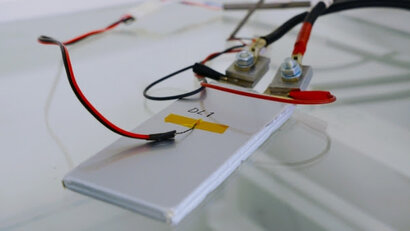
The third test measuring the properties of Donut Lab’s solid-state battery evaluated the battery’s ability to retain charge when not in use.
“Since we unveiled the Donut Battery, there has been a lot of speculation and theories about whether it is a supercapacitor” said Ville Piippo, CTO at Donut Lab. “In all its simplicity, this test proves that it is a battery. Supercapacitors charge and discharge quickly, but they also lose their charge quickly when not in use. The Donut Battery behaves like a battery and can maintain a charge for significantly longer.”
The battery charge retention measurement was carried out using a fairly simple research setup. The Donut Battery was connected at room temperature to the research laboratory’s battery tester, which repeatedly measured the cell voltage every 10 seconds. As in the previous test, which measured battery performance at very high temperatures, the third test also began with a 1C capacity test. This demonstrated that the cell was precisely the same as the other test examples.
After the capacity test, the battery cell was charged to approximately 50 percent charge and left connected to the battery tester for ten days. The cell was then discharged to measure the remaining energy capacity. The results show that the battery cell voltage stabilises during the first 10 hours after charging. Over the next nine or so days, the voltage curve continues to stabilise. A capacity test at the end of the test period confirmed that the voltage drop corresponds to the amount of energy in watt-hours.
The Donut Battery behaved in the test exactly as a battery should. If the test had been performed with a supercapacitor, the charge would have fallen linearly much faster during the same time period.
For additional information: