
The funding was made available through the UK government’s DRIVE35 Scale-Up Fund, delivered by the Department for Business and Trade in partnership with the Advanced Propulsion Centre UK (APC) and Innovate UK.
Located in Plymouth, Devon, ACT3 will be the UK’s first commercial refinery for recovery of critical battery materials from end-of-life EV batteries. It will have the capacity to process 24,000 EV batteries per year, producing high-value battery intermediates including nickel mixed hydroxide precipitate (MHP), lithium sulphate and graphite, which are all essential components for next-generation battery manufacturing.
By recovering these materials from recycled feedstocks, Altilium is establishing a domestic circular supply chain for low carbon battery materials in the UK, reducing reliance on imported raw materials, strengthening energy security and supporting the UK’s automotive sector.
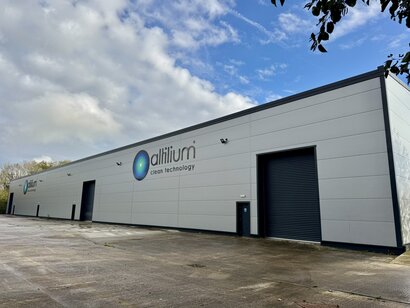
Construction of the building housing the facility has already been completed, but installation of the interior fittings and recycling equipment is expected to commence in summer 2026, with commissioning planned for end of 2027. Once this has been completed and the facility is fully operational, ACT3 will produce approximately 5,200 tpa nickel MHP, 8,000 tpa lithium sulphate (1,000 tpa LCE) and 5,400 tpa graphite, directly offsetting primary extraction and supporting the onshoring of EV battery supply chains.
The expansion is expected to create 70 new high value jobs in Plymouth, where Altilium already operates the UK’s only hydrometallurgical pilot plant for EV battery recycling. The project will also provide the foundation for the company’s industrial scale ACT4 recycling plant in Teesside, which will have capacity to process 150,000 EV batteries per year, producing 30,000 tonnes per year of cathode active materials (CAM).
“This funding marks a pivotal moment for Altilium and for the UK’s battery ecosystem” said Christian Marston, Altilium COO. “By scaling our recycling technology and building the UK’s first commercial facility of its kind, we are closing the loop on battery materials and enhancing the growth, productivity and competitiveness of the UK automotive supply chain. We are grateful to the APC and the UK Government for this strong vote of confidence in our technology, our team and our role in building a domestic, circular battery supply chain.”
The £18.5 million grant funding is expected to unlock further private finance from new investors and existing shareholders. Altilium has secured over £17 million private investment to date, including strategic investments from SQM, Marubeni Corporation and Mizuho Bank.
Construction of the facility will industrialise Altilium’s proprietary hydrometallurgical recycling technology, which is capable of recovering over 95 percent of cathode and anode materials from battery waste. The technology has been validated at pilot scale, supplying battery-grade materials for cell trials under previous APC supported projects with JLR and Nissan. According to an independent lifecycle assessment (LCA), these recycled materials deliver up to 74 percent lower emissions than mined alternatives, enabling a greener and more secure UK automotive supply chain.
MHP is an intermediate nickel-cobalt product used for producing battery-grade nickel sulphate for use in high-energy-density EV batteries. Currently Indonesia is by far the largest global supplier of MHP, while China dominates the refining and supply of lithium and graphite. In the UK alone, demand for lithium is expected to increase by 1,100 percent by 2035, according to the UK Critical Minerals Strategy.
The planned facility will serve as a cornerstone for the UK’s emerging battery recycling infrastructure. According to the APC, total battery scrap from portable electronics, manufacturing scrap and end-of-life EVs in the UK will reach 110,000 tonnes by 2035. The UK has no capacity for at-scale refining of battery waste, which is currently exported to Asia for processing, leading to loss of jobs, critical minerals and revenues.
Delivered by the Department for Business and Trade in partnership with the Advanced Propulsion Centre UK (APC) and Innovate UK, the DRIVE35 programme is part of the UK Government’s Advanced Manufacturing Sector Plan, which outlines its commitment to a zero-emission future, with an unprecedented £4 billion of grant funding available to 2035 for automotive R&D, scale-up, and transformation. The Scale-up Fund, which is delivered through the government’s DRIVE35 programme, is designed to bridge the gap between innovation and transformation.
For additional information: