
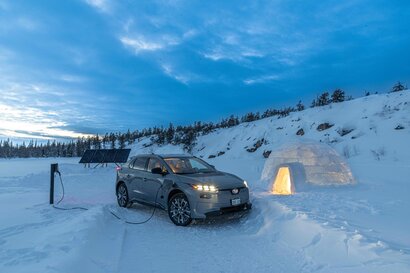
The trial, carried out in collaboration with technicians from the Territory and observed by members of the local Inuit community, saw an electric Subaru Solterra charged using a test rig comprising four latest-generation solar panels connected to an Ecoflow battery and inverter system. Despite the challenging February light conditions, the vehicle charged reliably at approximately 25 percent of the speed of a conventional 7kW home or public charger.
The project highlights the potential of smart, flexible charging solutions in some of the most remote and climate-impacted regions on Earth.
“Together with Subaru, we’ve demonstrated that smart EV charging can operate beyond traditional grid infrastructure” said Anthony Fernandez, CEO of Easee. “Using portable solar power in sub-Arctic conditions, we’ve shown that electrification is viable even in remote environments. Our purpose is to make electrification effortless for everyone. That includes communities that depend on transported fuel and face increasing climate pressure. With renewable generation, storage and intelligent charging working together, clean mobility can strengthen energy resilience and reduce reliance on imported fuels.”
Climate change is impacting Canada’s Arctic and sub-Arctic regions at a rate three times faster than temperate and tropical zones. In recent years, forest fires have forced evacuations in Yellowknife, while drought conditions have affected water supplies. At the same time, the cost of living has surged as communities remain heavily reliant on fossil fuel flown or transported in over vast distances.
“This project was a natural fit for the Subaru Solterra” added Madison Marple, PR Specialist with Subaru Canada. “It’s important to continue to demonstrate the durability and viability of electric vehicles in more extreme climates, and we are grateful for the help of Easee and our other project partners to bring this demonstration to life.”
With unpolluted skies and intense sunlight, solar power adoption is accelerating across the Northwest Territories, particularly in and around Yellowknife. More remote communities are now exploring how renewables, combined with electrification, can reduce fuel dependency and improve long-term resilience.
The pilot between Easee and Subaru demonstrates how smart EV charging infrastructure can operate far beyond traditional grid-connected settings – opening new possibilities for transport, energy independence and lower-emission living in the North.
The test also sparked enthusiasm within the indigenous Inuit community, who see portable renewable energy as key to maintaining their traditional, nomadic way of life.
Flexible, roll-up solar panels and portable wind turbines could in future be used to charge electric snowmobiles, enabling travel across traditional lands without carrying fuel.
During the demonstration, one local resident – born in an igloo – described green technology as critical to maintaining relevance for future generations. Electricians even connected the electric vehicle to power a light inside an igloo, illustrating the versatility of EV batteries as mobile energy sources.
The successful charging of a Subaru vehicle using solar energy alone reinforces the potential for electric transport solutions in regions where logistics, fuel costs and environmental pressures are increasingly challenging.
As the Arctic grows in strategic and environmental importance, scalable, smart charging solutions will play a crucial role in enabling sustainable mobility. The Northwest Territories pilot provides a blueprint for how renewable generation, battery storage and intelligent EV charging can work together – even in extreme climates.
Easee has designed its smart charging technology with the aiming of integrating seamlessly with renewable energy systems, optimising charging performance while supporting grid stability where grid infrastructure exists. In off-grid scenarios such as this pilot, the technology demonstrates its flexibility and robustness in harnessing distributed clean energy sources.
By proving that solar-powered EV charging is viable in one of the world’s most challenging environments, Easee and Subaru have taken a significant step toward making zero-emission mobility a practical reality for remote communities.
For additional information: