
That creation was an early version of the RTX Hybrid-Electric Flight Demonstrator’s experimental propulsion system for a regional aircraft. It will pair a thermal engine with an electric motor – and, the team hopes, tap into a new era of fuel efficiency for aviation.
The project is supported by the Canadian federal government and provincial government of Quebec along with a range of partners across industry and academia. It also reflects RTX’s company-wide approach to innovation; it combines an advanced thermal engine from Pratt & Whitney Canada, a 1-megawatt electric motor from Collins Aerospace, and a 200-kilowatt-hour battery system from the startup H55, backed in part by RTX Ventures, the company’s venture capital arm.
The goal of the project is to show a 30% improvement in fuel efficiency compared to today’s most advanced regional turboprops. The team also hopes the project will show what’s possible in designing future aircraft.
“Pratt & Whitney is the quintessential thermal engine maker, and Collins Aerospace is the quintessential aircraft system supplier on the planet,” said David Venditti, Pratt & Whitney’s program manager for the demonstrator. “There’s no other place really in the world where we have all of those experts and resources coming to bear and developing a technology like this.”
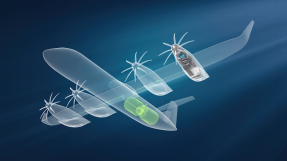
The demonstrator combines an advanced fuel-burning thermal engine from Pratt & Whitney with a 1-megawatt electric motor built by Collins Aerospace. A special gear system connects the two and keeps the propeller turning, whether the power comes from the engine, the motor, or both.
That question depends on the stage of flight. The thermal engine will power the plane during cruise, and the electric motor will do most of its work by helping with the taxi stage, as well as the power-intensive flight modes of takeoff and climb.
The motor will get its energy from a battery pack with a 200-kilowatt hour capacity – enough to power the average American home for nearly a week.
Thermal engines convert only about 30% to 40% of their fuel to useful energy – the rest is lost to heat or friction between moving parts. Electrical systems are more efficient, converting more than 90% of their energy into mechanical power.
Electric systems are common in cars, so why haven’t they taken to flight? There are two main challenges: weight and managing high voltage.
Hybrid-electric propulsion for a regional aircraft requires thousands of battery cells linked together operating at high voltage levels. That creates a risk of overheating or electrical arcing, where electricity jumps from its path and forms a miniature lightning bolt between the battery and something next to it.
Having to solve for arcing is a relatively new problem in aviation, Venditti said.
“The voltage level we’re using for our system surpasses anything that’s in production right now in aviation,” he said. “Normally you don’t have batteries assisting in the prolusion of aircraft.”
The team is using several methods of protection, but one of the main solutions is the design of the battery itself.
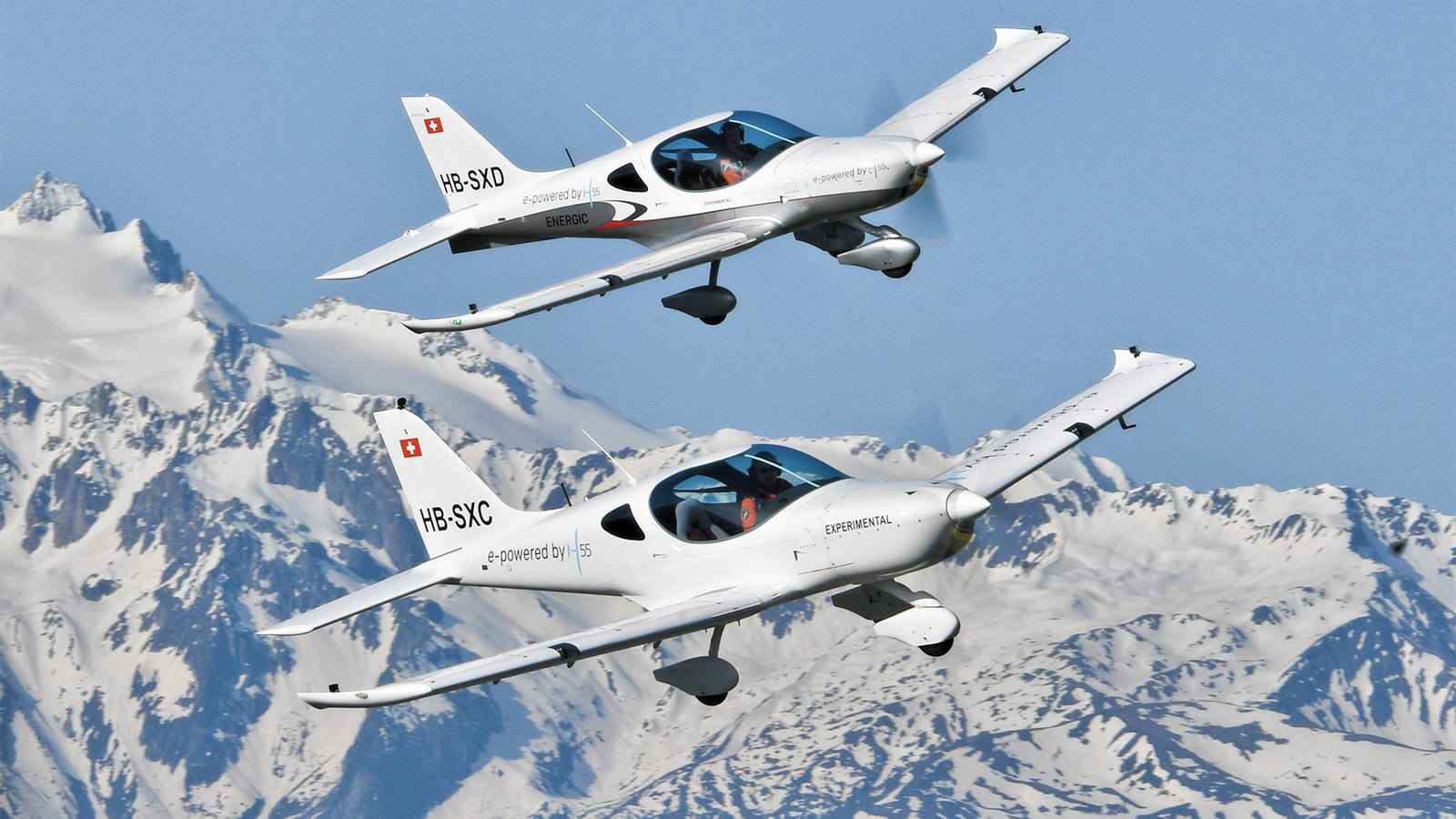
For help on the battery system, Pratt & Whitney enlisted H55, a Swiss company with backing from RTX Ventures. The demonstrator’s battery is based on technology H55 has already put into flight on smaller aircraft, including an all-electric two-seater.
RTX’s demonstrator is much larger but will rely on a modified version of H55’s existing system, with more batteries and added protections at the aircraft level. Pratt & Whitney Canada built on H55’s safety mechanisms with features specific to the demonstrator, including an extra fireproof box that can vent gases and flames in an emergency. It is also modular, meaning batteries can be installed throughout the aircraft to distribute weight.
By using a battery system whose baseline version is already in flight and has passed relevant European Union Aviation Safety Agency tests, Pratt & Whitney can take advantage of a system that’s designed for safety and proven compliance, said Anthony D’Ambrisi, who leads design, testing and certification for H55’s electric propulsion systems.
“Our team has built and flown six airplanes with more than 2,000 hours of electric flight time without any incident,” D’Ambrisi said. “H55 has accumulated hands-on experience in certification and airplane integration, allowing us to deliver Pratt & Whitney with a safe, efficient and certifiable product.”
H55 is a spinoff of Solar Impulse, a project that resulted in an airplane that flew around the world powered by just solar panels and batteries. That accomplishment, D’Ambrisi said, showed H55’s cofounders that electric propulsion was no longer a technology of the future.
“A lot of people from the aerospace industry were thinking it will be in the far future. We see the change arriving already today,” D’Ambrisi said. “I think the team here at H55 is proud to set the standard and show that this technology works well, it’s safe and can be certified. It’s real. It’s not just papers or presentations anymore.”
At RTX, the demonstrator has already marked many firsts. Teams at Collins Aerospace and Pratt & Whitney overcame many challenges as they modified the engine and electric motor and worked to integrate the two.
For example, it was the first time Pratt & Whitney had installed lithium-ion batteries in a test cell, which required building a special, ventilated cabinet the size of a small moving truck to house them. And it was the first time they had to charge a battery of its size – only there wasn’t a charger on the market that could do it, so they worked with the Innovative Vehicle Institute and the National Research Council of Canada to build one.
Over the next year, the RTX Hybrid-Electric Demonstrator team will continue ground testing and begin working with AeroTEC in Moses Lake, Washington, to install hardware on the aircraft. As they prepare for their first flight, they’ll meet the same rigorous safety standards that they would for certification while setting precedents for new standards, which will provide valuable insights for future projects.
While they’ve already demonstrated their concept, taking it a step further to flight will show its true potential and answer more questions about how to best use hybrid-electric propulsion.