
Hydrogen's role in Land Transport Decarbonisation sets out the case for hydrogen across road, rail and off-road transport applications where electrified options do not meet operational or commercial requirements.
Rather than competing with battery-electric technologies, the report argues that hydrogen should be deployed alongside them in the applications where it offers the greatest operational and commercial advantages.
Drawing on ten real-world case studies from across the sector, the report highlights how hydrogen can support the decarbonisation of heavy goods vehicles, commercial fleets, construction equipment, specialist rail operations and other demanding transport applications.
The report argues that adopting a multiple-technology approach would help reduce infrastructure and delivery risks, support the UK’s energy security, and unlock significant economic opportunities.
It also warns that the UK risks falling behind countries including those in the EU, where hydrogen refuelling infrastructure is already being deployed along key transport corridors.
The HEA is calling on Government to:
Adopt a broader, multiple-technology approach to land transport decarbonisation that recognises hydrogen's role alongside battery-electric technologies;
Introduce a coordinated policy framework to stimulate both hydrogen vehicle deployment and refuelling infrastructure simultaneously;
Ensure hydrogen is fully reflected in future transport and hydrogen strategies across the Department for Transport, the Department for Energy Security and Net Zero, and the Department for Business and Trade; and
Explicitly include hydrogen internal combustion engines (H₂-ICE) within the Zero Emission Vehicle framework, in line with EU classification.
Hydrogen's role in Land Transport Decarbonisation also highlights the significant economic opportunity presented by hydrogen technologies, noting that securing a 10 percent share of the global hydrogen technology market by 2050 could contribute £46 billion annually to the UK economy and support more than 410,000 jobs.
The report was launched at an industry event in London attended by representatives from the Department for Transport, the Department for Energy Security and Net Zero and the HM Treasury, alongside hydrogen industry leaders and organisations contributing case studies.
The event explored how government and industry can work together to accelerate the deployment of hydrogen across land transport applications.
Amanda Lyne, Chair of the HEA's Land Transport Working Group and Managing Director of ULEMCo, presented an overview of the report, with contributors from across the hydrogen sector joining a panel discussion on the opportunities and challenges facing transport decarbonisation.
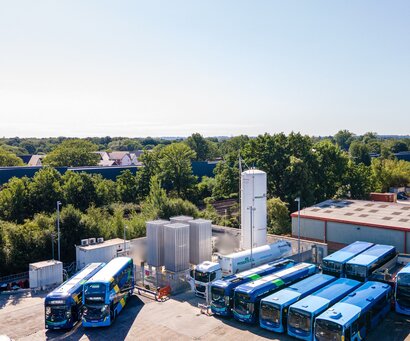
“The UK has a real opportunity to lead in hydrogen for land transport, but we are at risk of falling behind countries that are already investing in the refuelling infrastructure and policy needed to support its deployment” said Ms Lyne. “This report makes clear that there is no one-size-fits-all solution to decarbonising land transport. Battery-electric technologies have an important role to play, but so does hydrogen. Different applications require different solutions, and for many road, rail and off-road use cases hydrogen offers clear operational and commercial advantages. The case studies featured in this report, such as Air Products' Metrobus Refuelling Station and National Gas' fleet decarbonisation, demonstrate both the scale of the decarbonisation challenge and the practical role hydrogen can play in addressing it. They show why giving operators a choice of technologies is so important, enabling them to adopt the solution that best meets their operational and commercial needs. We hope this report will support ongoing collaboration between industry and the Government to ensure future policy reflects the full range of technologies available.”
The report concludes that hydrogen should be viewed not as an alternative to battery-electric technologies, but as a complementary solution that can help decarbonise applications where electrification alone is unlikely to meet operational or commercial requirements.
Adopting a multiple-technology approach will provide greater resilience, reduce long-term system costs and help ensure the UK remains competitive in the rapidly growing global hydrogen economy, says the HEA.
For additional information: