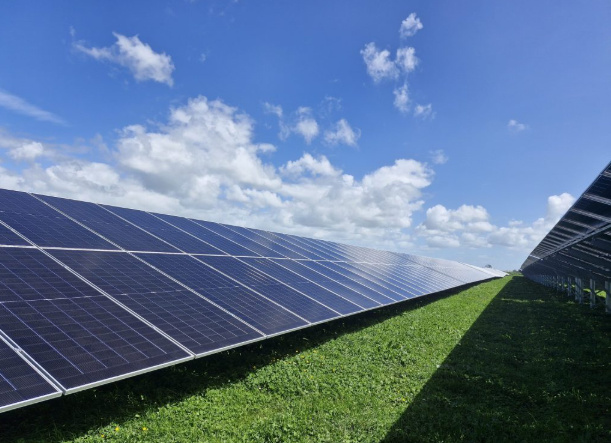


Wind and hail account for a significant share of physical damage claims at solar farms. Freeze events, while rarer, tend to cause some of the costliest repairs when they occur. The reason is largely that panels and mounting systems are often specified to a generic industry standard rather than the specific climate realities of a given site.
Racking that’s mounted to the ground should be rated for the highest wind speeds a region has historically produced, reducing risks of complete operational catastrophe during a hurricane. In hail-prone areas, panel glass thickness and mounting angle both affect the extent of impact damage from a storm.
Sites in colder climates must also account for freeze protection, as ice can crack components that hail alone wouldn’t damage. Insulating exposed wiring and specifying freeze-rated components during design is far cheaper than replacing cracked housing after the fact. This is especially important considering freeze-related claims average considerably higher costs than most other damage categories.
Flooding can be easy to underestimate because it doesn’t require a coastal site or a named storm to cause damage. A location can look low-risk on paper and still experience standing water during a heavy rain event that overwhelms local drainage, rather than a nearby river or coastline. This means that where the equipment is located and how well it’s sealed are integral to strong flood defense.
Critical components like inverters and switchgear should be positioned above ground level. This is highly important, as a location’s flood risk compounds over a system’s operating lifetime. Additionally, sealing conduit runs prevents water from traveling into equipment through paths that aren’t obvious until after a flood has already happened.
Wildfire risk at a solar farm can quickly and silently escalate, usually starting with dry vegetation catching fire near equipment or an electrical fault igniting nearby brush. In these situations, whether the outcome is an inconvenience or a major disaster depends on how quickly the ignition is contained. With climate change and human actions causing a surge in wildfires in recent years, preparedness is imperative.
Vegetation management is an often-overlooked first line of defense. Keeping growth cleared away from racks and transformers removes the fuel that allows a small ignition to spread across an entire array. The second, less obvious practice is to coordinate directly with local fire departments before an emergency occurs. Communicating with departments that have implemented innovative technological structures in their operations often leads to better response times and greater readiness.
Earthquakes pose a different risk because the damage to components is caused by the ground and mounting structure moving beneath them. In such circumstances, facilities built on rigid connections that can’t absorb sudden movement, cracking foundations, shearing off panel-to-rack fasteners or snapping conduit ends up feeling the full weight of the impact.
The fix is mostly about flexibility. Foundations in seismically active regions should be engineered for the region’s expected ground acceleration. Racking systems benefit from flexible joints that absorb movement. At the same time, conduit should be run with enough slack to move with the structure rather than snapping under sudden displacement.
Post-event inspection is also critical. A foundation can develop hairline cracking during a quake that isn’t visible until months of settling or freeze-thaw cycles worsen it, making a scheduled inspection after any significant seismic event a necessity.
Even with these measures, no solar farm is fully disaster-proof. A facility with high recoverability prioritizes preparedness. By building a strong foundational awareness of a specific site’s climate reality and understanding the structural frameworks needed to mitigate weather impacts, operators can make strategic decisions that cost far less than fixing a problem after the fact.