
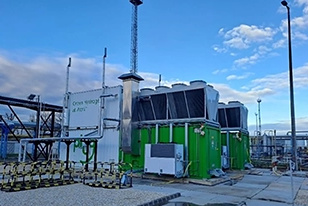
Since the project's initial announcement in October 2025 , with the delivery of the first 10MW GenEco electrolyzer module, all ten arrays (100 MW) have now been delivered and installed on site at the refinery.
“This installation demonstrates that large-scale green hydrogen is not just possible, it's happening today and Plug is instrumental in this effort,” said Jose Luis Crespo, President and Chief Revenue Officer of Plug. “The completion of the Sines Refinery project is a defining moment for Europe's energy transition and a model for the decarbonization of hard-to-electrify industrial sectors.”
“Projects like Sines underscore why Europe remains one of Plug's most important strategic markets,” said Benjamin Haycraft, Chief Strategy Officer at Plug. “We continue to invest across the region to support large-scale decarbonization, and this milestone demonstrates our ability to deliver real infrastructure that advances Europe's energy transition and strengthens long-term energy resilience.”
“With this pioneering project, Galp is closer to producing green hydrogen at an industrial scale, a historic moment for European refining,” said Ronald Doesburg, Executive Board Member responsible for Galp's industrial activities. “It is also a key step in the development of a new generation of low-carbon fuels that will enable the decarbonization of activities that cannot be electrified,” he added.
Plug's GenEco electrolyzers are supported by a global supply chain, integrating components manufactured across the US and Europe, combining regional expertise with scalable PEM technology. The project reinforces Plug's leadership in delivering modular, high-performance hydrogen systems at an industrial scale.
The Sines project is part of Plug's strategic expansion in Europe, which includes multi-gigawatt electrolyzer deployments across Spain, the UK, and beyond, supported by a $2 billion global opportunity funnel. Plug continues to advance hydrogen solutions across industries, positioning partners to decarbonize operations while maintaining competitiveness as low-carbon fuels grow their market share.