
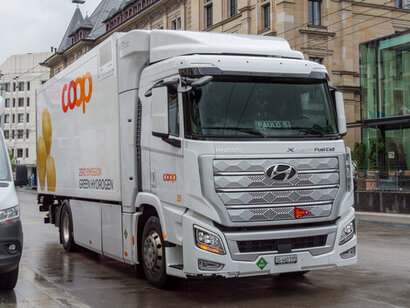
Hydrogen fuel cell heavy-duty trucks offer a cleaner alternative to diesel transport, but public support is essential for large-scale adoption. In a new study, researchers surveyed households in South Korea to measure willingness to pay for expanding hydrogen truck deployment. The results show strong public acceptance, with benefits exceeding carbon reduction costs, indicating the policy is socially profitable and supports long-term low-carbon transport transitions under national climate policy goals frameworks.
Governments worldwide are increasingly adopting policies to reduce carbon dioxide emissions in response to the growing environmental challenges posed by climate change. Within the mobility sector, a major priority is replacing conventional fossil fuel based internal combustion engine vehicles with low carbon alternatives, such as battery electric vehicles and hydrogen fuel cell vehicles. Heavy duty trucks, which account for a disproportionate share of transport emissions, have become a key focus of these decarbonization strategies.
In South Korea, the government has outlined an ambitious plan to decarbonise freight transport by expanding the deployment of hydrogen fuel cell heavy duty trucks. The policy targets an increase to 30,000 hydrogen fuel cell trucks by 2040, accompanied by a corresponding reduction in conventional diesel-powered vehicles. If implemented, the transition is expected to reduce carbon dioxide emissions in the mobility sector by approximately 8.74 million tons.
The researchers evaluated public acceptance using a contingent valuation approach, a widely used economic method for estimating willingness to pay for non-market goods. Data were collected through one-on-one interviews with 1,000 households across South Korea in 2024. Respondents were asked how much they would be willing to pay annually, through income tax, to support the hydrogen truck expansion. The study was made available online on 29 September 2025 and have been published in Volume 174 of the journal Transport Policy on 1 December 2025.
“This is the first study to quantitatively assess public acceptance of expanding hydrogen fuel cell heavy-duty trucks, not passenger cars or buses” said co-author of the study, Professor Seung-Hoon Yoo.
The analysis revealed that the average annual willingness to pay per household amounts to KRW 3,121 (USD $2.28) from 2024 to 2033. When aggregated nationally and discounted at a social discount rate of 4.5 percent, this equals a present value of KRW 572.4 billion (USD $418.4 million). In 2024 terms, the estimated willingness to pay per ton of carbon dioxide reduction is KRW 65,465 (USD $47.85), far exceeding the prevailing carbon credit price of KRW 9,245 (USD $6.76) per ton.
These findings indicate that, despite high upfront costs for vehicles and refuelling infrastructure, expanding hydrogen fuel cell heavy duty trucks is a socially profitable investment.
Beyond valuation, the study also identifies practical barriers to adoption. Large-scale hydrogen refuelling stations are often located at bus depots, limiting access for freight vehicles. The researchers recommend expanding or relocating stations along key logistics routes and adjusting acquisition tax reductions to match those offered for hydrogen buses, thereby encouraging logistics companies to adopt the technology.
“In the long run, our research contributes to accelerating the decarbonisation of the logistics sector” Professor Yoo. “For the public, this means significantly cleaner air and delayed climate change impacts, as heavy-duty trucks are currently major emitters. Furthermore, our finding that the residents in the Seoul Metropolitan Area have a higher willingness to pay suggests that in the next 5–10 years, targeted education and promotion in non-metropolitan areas will be crucial to achieving balanced national support for carbon neutrality.”
For additional information:
Seoul National University of Science and Technology (SEOULTECH)