
More recently there has been an uptick in demonstration plants and first-of-a-kind projects that highlight the transformative potential of molten salt. From the recent thorium molten salt reactor in the Gobi Desert to the demonstration project using stored renewable heat to generate industrial steam in Denmark, molten salt’s potential is expanding.
Much of this development is being driven by the need for a vast increase in the flexibility of the grid to support renewable generation. As a result, it has become increasingly necessary to utilize every avenue of energy storage; from batteries and pumped hydro to heat pumps and molten salt, each technology offers different advantages. At the same time, heavy industries are facing increasing pressure to decarbonize creating heightened interest in high temperature renewable heat technologies.
Molten salt and waste industrial heat
One of the factors that sets molten salt apart is its suitability for energy recovery in heat-intensive industrial settings.
Research by McKinsey suggests that the world produces at least 3,100 TWhth of waste heat across cement, steel, oil and gas, power generation, marine and other sources. Until recently, most industries took little notice of the potential for waste heat recovery; energy was inexpensive and heat recovery technologies had poor return on investment. Now the reverse is true, and there is also much greater pressure to reduce carbon emissions. With much of the low hanging energy efficiency options now taken, hard-to-abate sectors are now under the spotlight.
Molten salt can be used to both capture and store waste heat. It can then be recycled back into the industrial process as needed to reduce overall fuel consumption and carbon emissions. As molten salt has excellent thermal retention properties, when applied in this way, it almost becomes a ‘virtual circle’ with very little energy lost.
Expanding the potential of molten salt
To make molten salt more technically and economically viable, innovation has been required to reduce costs while increasing operating temperatures. For example, in many applications, as well as being used as the thermal storage medium, molten salt is also used as the heat transfer fluid, offering a more efficient solution to traditional liquids such as oil and water.
Naturally, at different temperatures, molten salt has different viscosity and density, meaning equipment such as pumps must be capable of running efficiently and reliably while accommodating variability of the fluid. In addition, molten salt is corrosive, and its corrosion mechanisms are influenced by several factors including its composition, concentration of impurities, atmosphere, temperature, thermal cycling and metal composition.
This has led to the development of equipment using corrosion-resistant alloys such as nickel alloy. Additionally, the solidification temperature of commonly used molten salt has varied ranges - from 140°C to 500°C - so systems must be designed to maintain temperatures above the threshold for the respective mixture.
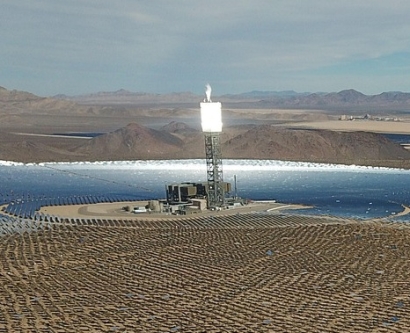
Finally, as molten salt is roughly double the density of water, it requires double the power to keep the same flow head. This has an impact on pump hydraulics and motors. In the case of concentrating solar plants with a central receiver tower, pumps must handle high flow, high head and high temperatures all at once – a major engineering challenge.
Accommodating all these requirements can be costly, so innovations are ongoing to explore how to reduce the cost of equipment while maintaining the same reliability and longevity that operators have come to expect. For example, more powerful vertical turbine pump technologies have been developed to increase head, allowing for taller central receiver towers to be built.
In addition, the third generation of molten salt applications for concentrating solar power, which could operate at temperatures up to 750°C, is now being conceptualized. Improved resistance to thermal stress and expansion as well as superior seals are just some of the developments needed to advance the technology.
Research and development in action
Altogether, improving the economics and technical capabilities of molten salt to expand its potential applications is a noteworthy challenge. However, the rapidly changing requirements have not phased everyone, in fact, some of us relish the opportunity to advance molten salt applications.
Industry pilot programs have already proved the concept that energy from renewables can be stored at temperatures up to 700°C, and can later be used to generate low carbon steam for electricity or heat for a wide range of industrial processes and community applications.
This approach provides a cost-competitive route for decarbonization in hard-to-abate industries and a lower carbon alternative to traditional methods. There is ongoing work in this space focused on achieving further material and technical development to extend service life, boost performance and deliver value.
Over the past two to three decades, there has been significant development in molten salt technologies. Backed by extensive research and several groundbreaking projects, the potential of molten salt is expanding all the time. When equipment providers are engaged in the project early, most challenges can be overcome through collaborative innovation.
By Benoit Martin, Advanced Engineering Manager, and Fernando Gimenez, Product Portfolio Manager, Sulzer