
The report, authored by the National Laboratory of the Rockies for the DOE Office of Energy Efficiency and Renewable Energy Water Power Technologies Office (produced while operating as the National Renewable Energy Laboratory (NREL)), evaluates the technical, economic, and geographic opportunity for structure-integrated wave energy systems in the United States.
The national laboratory analysis identifies structure-integrated wave energy as a comparatively lower-risk and higher-value deployment pathway within the broader marine energy sector.
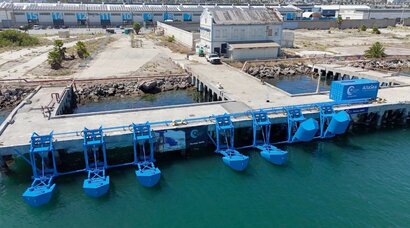
Unlike offshore wave projects that require standalone marine infrastructure, CSI-WEC systems are embedded directly into existing or planned coastal defence structures such as breakwaters, jetties, and harbour walls. This integration model:
Reduces capital intensity by utilising pre-existing infrastructure
Minimises subsea cabling and offshore installation complexity
Lowers operations and maintenance costs through onshore accessibility
Preserves the primary coastal protection function even if power generation is temporarily offline
The report concludes that this dual-use infrastructure model offers a more practical and financially attractive route to commercial marine energy deployment.
According to the study:
US coastlines contain an estimated 2,640 terawatt-hours per year of theoretical wave energy potential
Approximately 14 percent of US coastline is already hardened with coastal defence structures
Nearly 40 percent of the US population lives in coastal counties, many facing increasing erosion and flooding risks
As climate change accelerates coastal hazards, investment in sea walls, breakwaters, and harbour reinforcements is expected to rise. The report emphasises that integrating wave energy converters into such infrastructure can meaningfully enhance lifetime asset value by transforming passive defence structures into revenue-generating clean energy assets.
The national laboratory's techno-economic analysis and GIS-based siting tool indicate that CSI-WEC deployments may achieve:
Capital payback periods estimated at approximately five to six years
Potential for millions of dollars in energy value over a 20-year project life
Scalability from microgrid applications to grid-level generation depending on available linear infrastructure
The research team highlights CSI-WEC systems as a high-value marine energy application that has historically been underexplored in the United States despite favorable economics and infrastructure synergies.
Eco Wave Power was one of only three wave energy developers selected to perform preliminary energy production analyses for four high-potential US locations:
Puerto Rico
Hawaii
The Pribilof Islands
Humboldt Bay, California
Initial results demonstrated meaningful near-term deployment potential, with projected annual generation ranging from tens to hundreds of megawatt-hours per device under normalised 10-metre deployments, and the ability to scale output with extended infrastructure length.
The report's conclusions align with Eco Wave Power's demonstrated operational experience integrating wave energy systems into existing coastal structures, including:
A grid-connected project developed in partnership with EDF at Jaffa Port, Israel (EWP-EDF One Project), delivering electricity to the national grid
The Company's first US demonstration project at the Port of Los Angeles, marking a significant milestone in introducing onshore wave energy technology to the American market
These deployments validate the structure-integration model highlighted in the national laboratory study.
“This independent national laboratory report underscores what we have consistently believed and demonstrated in the field: structure-integrated wave energy represents one of the most economically rational and deployable pathways for marine energy in the United States” said Inna Braverman, Founder and Chief Executive Officer of Eco Wave Power. “By converting coastal defence infrastructure into clean energy assets, we are not only strengthening community resilience but also unlocking new revenue streams and accelerating the transition to renewable power.”
For additional information:
Report here.