
This cooperation supports the EU–Japan Competitiveness Alliance launched in July this year by strengthening supply chain resilience, reducing strategic dependencies and diversifying critical-minerals value chains. It also deepens energy cooperation under the existing EU–Japan Green Alliance across batteries, hydrogen and next-generation solar, supports critical and emerging technologies.
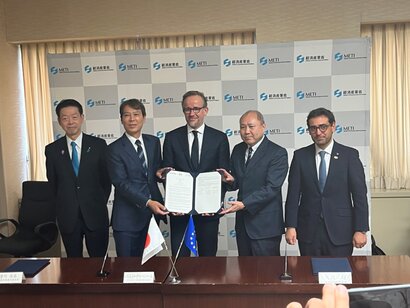
“Our success towards carbon neutrality will largely depend on our ability to innovate in clean technologies” said Stéphane Séjourné, Executive Vice-President of the European Commission for Prosperity and Industrial Strategy. “For this, Europe needs solid and close partners like Japan. The MoU signed between European and Japanese businesses today marks a new step to increase investments, and develop commercial opportunities, for our respective clean tech value chains. And a concrete new milestone on our common journey to fight climate change.”
The participants will identify areas of cooperation, and work in close partnership to broaden and deepen trade and investment ties by promoting investment in clean tech startups, stimulating business activities between private enterprises in the EU and Japan.
“Europe and Japan share a long tradition of industrial leadership, technological excellence, and clean tech innovation” added Diego Pavia, CEO of InnoEnergy. “By connecting our ecosystems, we can put this strength to work: by fast forwarding clean commodities manufacturing and adoption within industries such as electricity-based sustainable aviation fuels, clean steel, decarbonised iron, decarbonised cement, batteries, and photovoltaics; by mobilising capital for CAPEX heavy startups; and by building resilient supply chains that withstand global uncertainties.”
Cooperation will focus on attracting investment across the clean tech value chain, providing startups, investors and companies with access to information and new partners, and knowledge-sharing on investment-promotion activities.
The participants will exchange information on opportunities in strategic value chains such as batteries and hydrogen, facilitate business cooperation through their networks, co-organise activities for networking and knowledge exchange, and share market and policy insights to strengthen resilient cleantech supply chains.
For additional information: