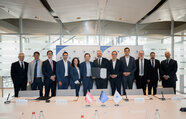

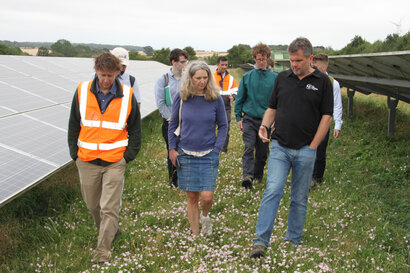
Professor Emily Shuckburgh CBE, accompanied by Clean Power Commissioner Craig Bennett, Hing Kin Lee from NextEnergy Capital, ecologist Guy Parker and others, visited Emberton Solar Farm near Milton Keynes. The nine-megawatt site, owned by NextEnergy Solar Fund and managed by NextEnergy Capital, is one of the company’s exemplar sites, actively managed to support biodiversity.
Just before the tour began, a red kite swooped low over the site, looking for small mammals, followed later by a common buzzard. Other wildlife seen included brown hares, starlings, green finches, ladybirds, meadow grasshoppers, tortoiseshell, meadow brown and small blue butterflies and a seven-spot ladybird. The site also has a family of resident barn owls. These all ultimately benefit from the site’s rich plant life, with yellow rattle, honeysuckle, ladies’ bedstraw and field knapweed particularly prominent.
“It's amazing” said Professor Shuckburgh. “We saw hares darting between the panels. We saw plenty of butterflies and grasshoppers - loads of different species. So you can see elements of nature coming back to life, at the same time as us generating a clean energy future. This is a vision of hope.”
As Chief Scientific Adviser to the Department of Energy Security and Net Zero, the professor provides independent and impartial science and engineering advice to ministers and policymakers to further the Government’s Clean Energy Superpower Mission. Before founding the University of Cambridge’s Cambridge Zero initiative in 2019, the renowned climatologist worked for over a decade at the British Antarctic Survey. She was awarded a CBE last year, having acted as an adviser to the Government in other capacities, such as during the COP26 climate conference in Glasgow.
“We know that we live one of the most nature depleted countries in the world” added Mr Bennett, himself an member of the Government’s Clean Power 2030 Advisory Commission. “We know we need to restore nature and the wider countryside. Obviously, we need really good protection of our designated sites – sites of special scientific interest, for example. But in the wider countryside, the potential to restore nature alongside and actually integrate it into essential clean energy infrastructure just like this, it's really there. When you think you've got the wildflower meadows around the outside and obviously decent grass and habitat in the centre as well, I think it just goes to show that we’re only just starting the story about how we can make sure renewable energy infrastructure can be nature positive.”
There are three great benefits that solar farms provide, Bennett said: the production of food (through grazing livestock such as sheep, and increasingly commonly the production of honey), achieving clean power production and answering, “the desperate need to restore nature at scale to reverse the nature crisis”.
“I think we need to start seeing how we can have win, win, wins here, rather than trading one thing off against another” Mr Bennett said.
“Absolutely” replied Professor Shuckburgh. “I think it's that integrated, whole-systems approach where we're looking at climate, we're looking at nature, we're looking at energy provision, we're looking at food provision, we're looking at community benefits all together and creating solutions that work in that holistic sense.”
“Emberton is an excellent example of how species-rich grasslands can be integrated into a solar farm, increasing both botanical and pollinator diversity greatly” added Guy Parker, Founder and Co-director of Wychwood Biodiversity. “Creating meaningful biodiversity gains on renewable energy sites is an effective way to tackle the climate and biodiversity crises.”
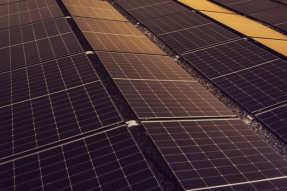
Emberton is a 17-hectare, solar farm in Buckinghamshire, powering the equivalent of 1,600 homes each year. It will remain in place for around the next 34 years.
The land consists of species-rich grassland, featuring two dedicated wildflower areas that were established eight years ago and ‘insect hotels’. Surrounding the panels are tall hedgerows to provide forage and nesting sites for birds, alongside visual screening.
Far more wildlife is on the site now than before it was developed. Biodiversity net gain assessments recorded a 123 percent increase in habitat units and a 45 percent increase in hedgerow units compared to before the site was built. The land was formerly used largely for grazing, which remains the case.
“We were delighted to welcome Professor Emily Shuckburgh, Craig Bennett and colleagues to one of NextEnergy Solar Fund's exemplar solar farms” said Hing Kin Lee, Group Lead for Nature at NextEnergy Capital and a Chartered Environmentalist. “Emberton demonstrates the significant opportunities that exist when renewable energy generation is combined with long-term ecological management. The increase in biodiversity recorded on site shows that solar farms can be more than energy assets - they can become valuable landscapes for nature recovery, supporting the UK's ambitions for clean power and a more resilient natural environment. The visit highlighted the growing recognition that well-managed solar farms can help deliver climate action, nature recovery, and sustainable land use together.”
Emberton is far from unique in being a highly biodiverse solar farm, as demonstrated by Solar Energy UK’s series of annual ecological monitoring reports, Solar Habitat. Launched in Parliament last month, the latest edition records sightings of 259 plant species, 77 species of birds – half of which are species of conservation concern – five species of bumblebee and 27 species of butterfly.
Adder, common lizard, grass snake, slow worm and sand lizard were all found on just one solar farm in Dorset, making it a ‘Key Reptile Site’ according to the reptile and amphibian conservation charity Froglife.
The potential for solar farms to deliver landscape-scale benefits for wildlife, while also delivering clean power, was recognised in guidance produced by the Royal Society for the Protection of Birds and a group of academics from the Universities of York and Lancaster, launched at the same event.
For additional information: