
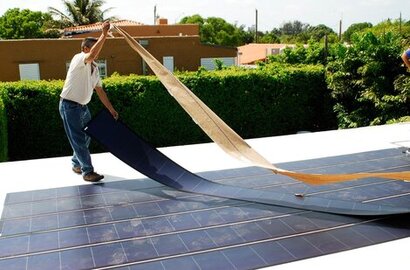
As the world urgently seeks clean energy solutions, solar power stands out for its abundance and scalability compared to other renewable energy sources. In recent years, researchers have turned to thin-film solar cell technologies as alternatives to traditional crystalline silicon solar cells, owing to their lower manufacturing costs, better reproducibility, and applicability in flexible electronics.
Devices equipped with tin monosulfide thin-film solar cells have long been limited in their performance by defects and unwanted reactions at the rear contact interface. However, researchers from Korea have now demonstrated that inserting an ultra-thin germanium oxide layer between the molybdenum back contact and SnS region mitigates these issues.
Their findings highlight how interface engineering can greatly boost power conversion efficiency, paving the way for improving performance in many such electronics and energy technologies.
Tin monosulfide (SnS) is among the most promising non-toxic and low-cost materials for thin-film solar cells. Unlike more established designs relying on scarce elements like indium, gallium, and tellurium, thin-film SnS is not only in line with the United Nation’s Sustainable Development Goals but also offers optimal optical and electronic properties for harvesting sunlight - at least in theory.
Despite multiple studies, scientists have struggled to achieve the full potential of thin-film SnS solar cells, with measured performances falling short of theoretical limits. A major reason behind this lies at the rear-contact interface, where SnS connects to the metal electrode. Here, structural defects, unwanted chemical reactions, and unintended movement of atoms limit the device’s ability to collect charges efficiently.
Against this backdrop, a research team led by Professor Jaeyeong Heo and Dr. Rahul Kumar Yadav from Chonnam National University, Republic of Korea, has made a substantial breakthrough in thin-film solar cell design. Their study, published online in Small on September 19, 2025, describes an innovative approach, which focuses on inserting an ultra-thin layer of germanium oxide (GeOx) between the molybdenum back contact and the SnS absorber layer.
The researchers employed a precise yet simple method to create this 7-nanometre thick GeOx interlayer. They exploited the natural oxidation behavior of a thin Ge film in a vapor transport deposition process, which is scalable and industry-friendly.
“Despite its nanoscale thickness, this interlayer addresses several long-standing challenges at once” said Professor Heo. “It suppresses harmful deep-level defects, blocks unwanted sodium diffusion, and prevents the formation of resistive molybdenum disulfide phases during high-temperature fabrication.”
These combined effects dramatically improve the quality of the SnS absorber, leading to larger, more uniform grains, enhanced charge transport and collection, and a significant reduction in electrical losses.
The implementation of this controlled GeOx interlayer resulted in a substantial boost in power conversion efficiency, increasing from 3.71 percent in standard devices to an impressive 4.81 percent. This marks one of the highest efficiencies reported for SnS-based solar cells produced using vapor deposition methods.
Notably, the ability to engineer precise material interfaces has wide-ranging implications beyond solar cells. For example, metal/semiconductor interfaces in thin-film transistors determine contact resistance and switching performance. Similarly, favourable interfacial properties are essential for high energy conversion efficiency in thermoelectric devices, sensitivity and charge transfer in sensors, mechanical stability in flexible electronics, and performance in photodetectors and memory devices.
“Across all these applications, mastering the metal/semiconductor interface remains central to advancing next-generation devices” added Professor Heo. “We believe that this work will open new avenues for research, contributing to the development of advanced solar cells and other key technologies.”
For additional information: