
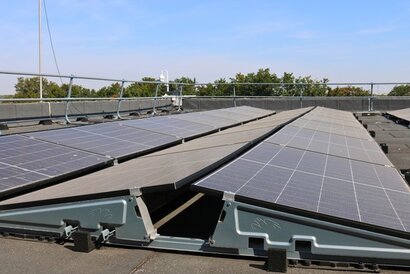
The report shows that the UK’s untapped commercial rooftops could become a major new source of solar energy generation with enough output to match that of 20 Hinkley Point C nuclear power stations. This, if utilised correctly, could massively increase UK renewable energy production, fast-track the UK’s path to net zero, improve national energy security, reduce the need for solar deployment on agricultural land, and drastically reduce energy costs for occupiers amid ongoing energy price uncertainty.
The report, which draws on data and respondents from 70 real estate organisations with combined assets under management (AUM) of over £500 billion, has found that less than 10 percent of suitable commercial building roofspace has been utilised for solar generation to date, providing just 3-5 GW of solar capacity.
While solar technology is widely championed in principle, its deployment remains significantly below its technical potential, particularly across the industrial and logistics real estate sector.
Unlocking the remaining 90 percent could provide a vast new source of home-grown renewable generation, with the potential for more than 60 gigawatts (GW) of untapped solar capacity to be harnessed across UK commercial real estate. It would also significantly reduce energy costs for occupiers and create additional revenue streams for landlords whilst rapidly decarbonising the UK’s built environment, which currently emits 25 percent of the UK’s greenhouse gas emissions.
This latent capacity (60 GW) is the equivalent of powering approximately 20 million National Grid enabled UK homes per year, or more than 10 times the AI data-centre capacity the Government expects the UK to need by 2030.
The report reveals the clear commercial case for rooftop solar installation, should the necessary financial, regulatory and legal frameworks be put in place. For a typical 300 kWp solar installation with a capital expenditure of £250,000, a tenant-funded installation could generate a 20 percent Net Yield in its first year and a payback period of just 5.5 years. For landlord-funded installation, Net Yield in the first year sits at 12 percent, with a payback period of 8 years. Whether the solar panels are installed by the landlord or tenant, both models present strong environmental benefits, saving 53 tonnes CO2e per year.
Solar power is also increasingly viewed as an essential element of asset modernisation, decarbonisation and future-proofing existing assets against tightening ESG regulations, meeting higher tenant expectations for building sustainability and helping to protect occupiers from volatile energy pricing. It would also significantly reduce the need for solar farms to be deployed on agricultural land, a positive given concerns around future food security and heightening scrutiny of solar installation in rural areas.
However, despite the many benefits, the report highlights that delivery constraints are a key barrier to wider roll-out, meaning that well-intentioned projects are delayed, downsized or not pursued at all. Whilst 85 percent of respondents expect rooftop solar activity to increase in the coming years, this will not happen without significant policy reform.
Financial viability remains one of the most persistent constraints on rooftop solar PV deployment in the UK commercial real estate sector. Mismatches between funders’ requirements and commercial leases, ambiguity in the REIT regime and insurance terms all hamper deployment. Other constraints include structural barriers such as leasing complexity, policy and regulatory uncertainty, grid capacity and connection delays as well as inconsistent commercial frameworks. The cumulative impact of these hurdles is the prevention of widespread, scalable solar deployment as well as market fragmentation.
In response, the report calls on the government to unlock the full potential of rooftop solar through seven clear recommendations. These include:
Remove tax and regulatory barriers by clarifying REIT rules for solar investment; broadening the REIT regime to include renewable energy; extending the business rates exemption for solar investment beyond 2035; and improving capital allowance reliefs.
Standardise legal and commercial frameworks such as PPAs and lease clauses to reduce complexity, cost and delays.
Introduce consistent insurance standards for rooftop solar to reduce design risk and avoid projects being downsized or abandoned.
Strengthen export revenues through more predictable long-term pricing mechanisms, making larger solar installations viable.
Accelerate grid reform and investment to improve connection times, increase capacity and provide clearer information for developers.
Provide long-term policy certainty, including clear implementation of MEES to support investment and make solar a standard feature of commercial buildings.
Maximise existing solar projects by increasing the 50kW cap on permitted development regimes with prior approval with local planning authorities
“Solar energy has a critical role to play in the UK’s energy transition, and commercial real estate has the potential to be a major player in the generation of rooftop solar” said Rob Wall, Assistant Director, Real Estate:UK. “However, as our research shows, deployment of solar on commercial buildings is slow and we are still some way off from delivering that long promised rooftop revolution. There is ambition – with 85 percent of real estate professionals expecting solar power generation from commercial buildings to increase over the next 24 months - but for that to happen we need a series of policy reforms as set out in today’s report.”
For additional information: