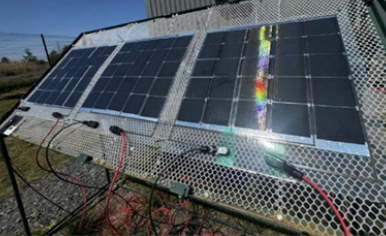
Power Roll’s perovskite solar cell adopts an innovative structure that does not require indium tin oxide (ITO), the material used in transparent conductive oxide (TCO) substrates that typically account for 40–60% of materials cost in conventional perovskite solar cells.
Because ITO uses the rare metal indium, it is expensive and poses a major barrier to cost reduction. Concerns also exist regarding stable supply due to depletion risks and country-specific geopolitical risks. While many companies across the industry are pursuing alternative materials, Power Roll has achieved a breakthrough by eliminating ITO altogether and forming electrodes on its proprietary micro-grooved film. By fundamentally removing the need for ITO through a re-designed cell structure, dramatic cost reductions—previously difficult with conventional technologies—are expected.
Overview of the Demonstration Project
In this Project, Tokyo Gas will apply its advanced installation technologies—including its proprietary adhesive-based construction method—together with its expertise in distributed energy system deployment and operation. Over approximately one year, the Project will monitor and evaluate power generation performance, durability, and other factors. The goal is to verify and improve performance and reliability under Japan’s climate and environmental conditions.
The two companies will also identify potential use cases in Japan, examine requirements for certification systems essential for social implementation, and explore the possibility of jointly building a manufacturing and supply framework (domestic supply chain) in Japan. Through this Project, Tokyo Gas and Power Roll aim to accelerate the social implementation of film-type solar cells, contributing to increased adoption of renewable energy in Japan and the realization of a carbon-neutral society.