
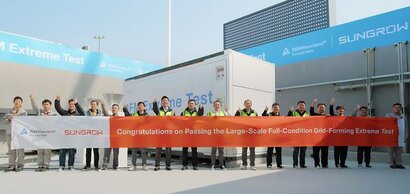
Grid-forming (GFM) inverters are advanced power electronics that establish and regulate voltage and frequency in modern power grids, acting as a voltage source to mimic traditional synchronous generators. They are crucial for integrating renewables and provide the necessary inertia, system strength, and black-start capabilities to stabilize grids with high inverter-based resource penetration.
As demand for grid-forming technologies grows, independent, full-scale validation is increasingly important. Sungrow's test base features a 30 MW grid simulation platform, real short-circuit capacity regulation equipment, and advanced arc-fault testing devices, enabling replication of complex and extreme grid conditions. The tests align with grid requirements across major global markets, including Europe, Australia, and China.
“Based on two decades of experience on grid-forming technology and in-depth understanding of power system stability requirements, Sungrow has built a 30 MW large-scale simulation platform and conducted 14 comprehensive real-world extreme test scenarios” said Henry Liu, General Manager of the Microgrid and Grid Solutions Center at Sungrow. “These results demonstrate grid-forming capabilities and mark a critical step toward the large-scale deployment of grid-forming technologies.”
Here the most important results:
A short-circuit test using real arc-fault equipment simulated severe fault conditions. Under identical scenarios, the grid-forming system remained connected and continuously supplied fault current, while conventional systems are more likely to disconnect. The response time was at 10ms, the test saw stable and continuous fault current contribution and a strong fault ride-through capability.
Compared with conventional grid-following systems, which may lose stability under the same disturbance, Sungrow's solution maintained continuous operation and restored frequency stability within milliseconds. The test showed Millisecond-level response to frequency deviations, Stable operation under sudden disturbances and improved system resilience in weak grids.
In a full blackout test, all external power was disconnected from the site. During this test, Sungrow's grid-forming Power Conversion System established system voltage within 19s, then successfully restarted the entire facility, restoring loads and infrastructure without external support. This capability enables industry-leading GW-scale black start and significantly enhances system restoration speed with virtually no circulation current.
In addition to the tests mentioned above, eleven further tests - including on/off-grid switching, load switching, and oscillation damping - were also successfully completed.
Sungrow has also successfully completed the conformity assessment conducted by the Notified Body (NB) TÜV Rheinland (NB No. 1008) in accordance with the EU Battery Regulation (EU 2023/1542) becoming the first company globally to complete NB assessment across utility-scale, commercial and industrial (C&I), and residential energy storage segments under the currently applicable provisions of the regulation.
The assessment covered requirements already in force, including safety, labeling and marking obligations, restrictions on hazardous substances, performance and durability, and battery-management parameters such as state of health (SOH) and expected lifetime.
“Sungrow's energy storage portfolio demonstrates strong performance in safety design, system reliability, and key technical metrics, fully meeting the stringent requirements of the EU Battery Regulation for stationary energy storage systems” said Bowen Dong, General Manager of PV&ES Product Services at TÜV Rheinland Greater China. “As the first company globally to complete NB assessment across utility-scale, C&I and residential energy storage segments under the applicable provisions of the regulation, Sungrow's achievement provides a valuable reference for the industry in addressing the evolving regulatory landscape in Europe.”
For additional information: