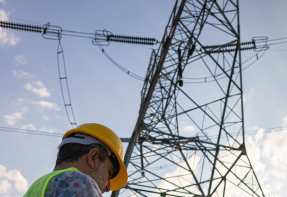
The three designers came up with the idea of using existing structures, i.e. electricity pylons, telecoms towers, etc., to locate small wind turbines as they commuted regularly on the TGV high speed train through France. They would invariably see wind turbines and electrical structures but never the two together; and so they set about finding a solution which would enable added value to be obtained from existing structures and would avoid the need to construct expensive, imposing wind turbines on new sites.
Nicole Delon has suggested that if a third of France’s electricity pylons were retrofitted with these turbines, they could generate the same amount of power as two nuclear reactors, i.e. approximately 5% of the country’s total electricity demand.
This idea comes at the perfect time for France, which plans to boost its wind power capacity to 10 GW by 2010. However, the design team is keen to point out that their project has universal applications and could be used around the world. “The genius of the proposal is that it solved probably the biggest issue of wind production which is where to locate these very large structures,” says Alex Andros Washburn, New York’s chief urban designer and a judge for the Next Generation competition, “By incorporating them into transmission towers, which are already located and of the same scale as wind towers, the idea of how it looks on the landscape is very cleverly integrated.”
New pylons or a retrofit?
The biggest question was whether to design new pylons or work on a retrofit design which would enable turbines to be incorporated into existing pylons. A new tower structure was initially developed called Wind-it XL, which allowed Rafael Ménard to account for an array of constraints: wind effects, structural stability, height, turbine placement, and electrical transmission; although everyone agreed that the concept needed to be broader. “There are half a million pylons already in France,” Ménard says. “If you look to other countries, there are tens of millions. Even if the power is tiny, as soon as you integrate it like that, it creates big, big energy.”
Consequently, a group of experts from the US including electrical and environmental engineers, a public-utility company, a sustainability consultant, and a wind turbine manufacturer, was appointed to review the proposal for technical considerations. They concluded that the retrofit concept would be tricky to justify financially as electricity pylons are not designed to accommodate extra weight such as a wind turbine and would therefore require structural reinforcement, which could be prohibitively complex. As a result, the three French designers focused their efforts on developing new dual-purpose pylons that incorporate turbines which can generate nominal energy, i.e. enough to power anything from a room in a house to 20 houses a year depending on their size and wind speeds.
Although the turbines used in the Wind-it design are initially more expensive than their propeller-design cousins, primarily because there is not much of a market for them, and questions exist about whether stacking turbines on top of one another from the ground up, as Wind-it does, is the most economical means of capturing scudding gusts, Wind-it has been well received, and not just by the judges of the Metropolis Competition. “There’s a slight naivety about the design,” says Chris Garvin, a partner with the environmental consultancy Terrapin Bright Green, “but it’s compelling nonetheless.”
Incorporating wind turbines into existing structures is not unheard of. Urban Green Energy, a wind-power start-up in New York, recently mounted turbines on the French telecom company Alcatel-Lucent’s cellular-communication spires. The turbines are almost identical to those used in Wind-it, although the major difference is that the Alcatel-Lucent system makes use of the power generated in situ, rather than feeding it into the electricity grid.
Taking Wind-it to a higher level
Although Wind-it made its public debut in May 2007 as part of an exhibition about energy and design sponsored by the French utility company Électricité de France, attracting attention from a number of possible sponsors, the design team is finding it hard to obtain funding in France to take its concept to a commercial level. “We have spent one and a half years meeting people and everyone says, ‘It’s interesting, but it’s really hard to make it real'. We’re not yet at a point of looking abroad, but maybe we have to,” says Delon. Turkey has already expressed an interest and is considering retrofitting its transmission lines, as have potential partners in the United States and Switzerland. On the other side of the world, China recently approved a $600 billion stimulus package – much larger than America’s as a proportion of GDP – a large portion of which is expected to be used to restart the frenetic construction of rail networks, airports and other infrastructure that the country had started before the global recession took its hold. Wind-it could be easily integrated into such infrastructure development.
Although Delon admits that Wind-it “is still a work in progress” the designers are committed to their concept. “We’re here to show potential, to make Wind-it real and serious. We want it to be built.” Now all they need to do is find an investor who concurs.