
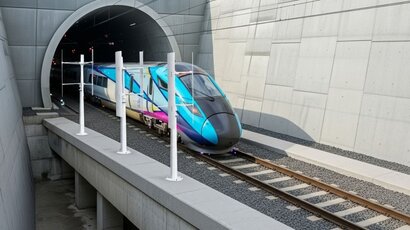
A team from the Department of Mechanical and Aerospace Engineering, working with industry partner Q-Sustain Limited, an engineering consultant based in Manchester, is designing innovative vertical axis wind turbines (VAWTs) that capture airflow generated by trains moving through tunnels – known as the piston effect.
The project, which begins with the Transpennine Route Upgrade project, will explore how this untapped energy source can be integrated into transport infrastructure, providing clean electricity and supporting the UK’s decarbonisation goals.
Early feasibility studies have already confirmed the potential of tunnel airflow, and the team has developed a bespoke techno-economic analysis (TEA) toolkit to evaluate performance and commercial viability of such designs. Available through VerXis Wind, the software offers a practical platform for assessing renewable energy projects, with potential applications beyond just rail.
The project, funded under EPSRC Impact Acceleration Account (IAA) and under the remit of ‘sustainable engineering and transport systems’, could transform how transport infrastructure is designed and operated in the future.
“Our VerXis toolkit represents a leap forward in renewable energy research” said Dr Amir Keshmiri, Academic Lead of the project at The University of Manchester. “By turning minimal tunnel geometry and schedule data into bank-level economic indicators in minutes, we're bridging the gap between academic innovation and real-world deployment, making piston-wind VAWTs not just technically viable, but genuinely investable.”
The next stage will see prototype turbines tested in real-world tunnel environments, alongside further development of the VerXis toolkit, with the ambition of influencing future rail energy standards.
“What excites us most about VerXis is its ability to rapidly test and scale turbine designs tailored to each tunnel environment” added Azhar Quaiyoom, Director of industrial partner Q-Sustain Limited. “This toolkit enables smarter, data-driven decisions, helping us deploy sustainable solutions in railway infrastructure that align with the UK's net-zero ambitions and calculates the return on investment for our clients”
If successful, the approach could be applied not only to rail but also to other transport networks, providing a scalable model for integrating renewable energy into infrastructure across the UK and beyond.
For additional information: