
Expected Market Growth and Size of the Biogas to Hydrogen Market
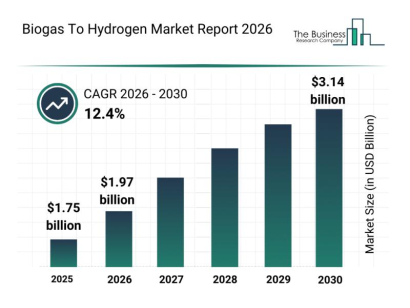
The biogas to hydrogen market is projected to experience rapid growth in the coming years, reaching a value of $3.14 billion by 2030. This growth corresponds to a compound annual growth rate (CAGR) of 12.4%. Key factors driving this expansion include increasing demand for low-carbon hydrogen, heightened investments to build hydrogen infrastructure, broader decarbonization initiatives, and heightened use of hydrogen in transportation and industrial sectors.
Additionally, technological advancements in reforming catalysts are playing a crucial role in boosting market growth. Prominent market trends during the forecast period include amplified deployment of biogas reforming systems, a rising preference for renewable hydrogen production methods, greater integration of cutting-edge reforming technologies, expansion of distributed hydrogen generation capabilities, and a stronger emphasis on feedstock versatility.
Primary Drivers Behind Biogas to Hydrogen Market Expansion
One of the main forces propelling growth in the biogas to hydrogen market is the surge in demand for sustainable, low-emission hydrogen. Governments and industries worldwide are prioritizing the reduction of carbon footprints, encouraging the transition from fossil fuels to greener alternatives such as hydrogen derived from biogas. This transition supports global climate goals and aligns with increasing environmental regulations.
Furthermore, significant investment inflows aimed at enhancing hydrogen infrastructure are accelerating market development. Funding is being directed toward establishing production plants, storage facilities, and transportation networks that support the broader hydrogen economy. These efforts are instrumental in enabling the widespread adoption of hydrogen technologies across various sectors.
Top Companies Leading the Biogas to Hydrogen Market
Several key players dominate the biogas to hydrogen market, including Air Liquide SA, Air Products and Chemicals Inc, Linde plc, Siemens Energy AG, Thyssenkrupp AG, Ivys Adsorption Inc., Hitachi Zosen Inova AG, ENGIE SA, Shell plc, Bioenergy DevCo, Greenlane Renewables Inc, EnviTec Biogas AG, Nel ASA, ITM Power plc, McPhy Energy SA, Plug Power Inc, Snam S.pA, BASF SE, Green Hydrogen Systems A/S, and Ballard Power Systems Inc.
A notable development occurred in February 2023, when Shell plc, a UK-based oil and gas giant, acquired Nature Energy Biogas A/S. This acquisition aims to solidify Shell's position in the renewable natural gas (RNG) market and to grow its integrated RNG operations worldwide. Nature Energy Biogas A/S, based in Denmark, specializes in producing hydrogen from biogas generated through agricultural, industrial, and household waste, offering renewable alternatives to traditional fossil fuels.
Significant Trends Shaping the Biogas to Hydrogen Industry
Leading companies are focusing heavily on technological innovation, especially in clean carbon-negative hydrogen production, to gain a competitive edge. Clean carbon-negative hydrogen involves generating hydrogen from renewable or waste-derived biogas where carbon emissions are permanently captured or utilized, resulting in net-negative greenhouse gas outputs.
An example of this is the launch in April 2025 by Utility and Ghena, a US clean hydrogen technology firm, of its H2GEN reactor system. This technology enables direct hydrogen production from biogas without the need for pre-upgrading, offers modular scalability, and achieves verified negative carbon intensity for applications such as mobility in South Korea. This advancement supports climate-positive hydrogen production, reinforces decarbonization efforts, and promotes circular economy principles, although challenges like technology commercialization and lifecycle validation remain to be addressed.