
Initiated by Mantle8 and led by Hydrogen Europe, the coalition's Open Letter urges the EU to explicitly recognise natural hydrogen in its energy and hydrogen policies, improve permitting procedures and mobilise investment to establish the resource's geological and commercial potential. The call comes as the European Commission prepares its renewed EU Hydrogen Strategy, with a call for evidence launched on 26 October explicitly referencing natural hydrogen as an emerging source for research and innovation.
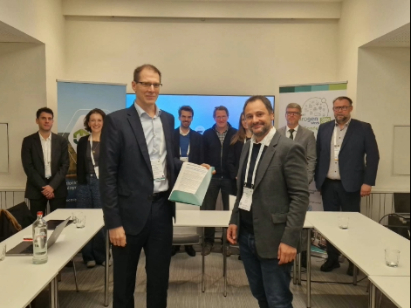
The letter was presented during a workshop at European Hydrogen Week in Brussels on 28 October, with an in-person ceremonial handover involving European Commission representatives. An official dispatch to the relevant Commission director-generals and commissioners is planned for the following week.
“We initiated this letter because Europe needs to give natural hydrogen a fair opportunity to be explored” said Emmanuel Masini, Founder and CEO of Mantle8. “The industry has the scientific expertise and technological capabilities to investigate the resource, but progress depends on having the right regulatory conditions in place. Clear rules, predictable permitting and investment in exploration would allow us to establish where natural hydrogen can be found, whether it can be recovered commercially and what role it could play in Europe's energy future.”
Natural hydrogen is generated by geological processes beneath the Earth's surface and can accumulate in underground reservoirs. Unlike hydrogen produced using electricity or fossil fuels, it occurs naturally underground and could provide a source of primary energy, subject to successful exploration, extraction and processing.
However, natural hydrogen remains an emerging exploration sector. Further fieldwork is needed to establish the scale, productivity and economic viability of potential resources.
The coalition argues that Europe risks falling behind other regions unless companies can move from geological research to systematic exploration. Although the European Commission has begun investigating the resource through initiatives including the EU-funded H2-QUEST research project and a DG GROW pilot study, the sector continues to face uncertainty over regulatory status, permitting requirements and access to geological data.
For exploration companies, these barriers create uncertainty around project timelines and investment decisions. The coalition argues that a coordinated European approach would help build the evidence base needed to identify promising resources and determine whether they can be developed commercially.
The Open Letter calls on the European Commission to recognise natural hydrogen explicitly in the 2026 Energy Union package and the forthcoming revision of the EU Hydrogen Strategy, alongside a proposed European Natural Hydrogen Initiative built around four priorities:
Clear regulatory recognition: Establish a technology-neutral policy framework for natural hydrogen, including eligibility for relevant EU certification and support where applicable emissions-saving criteria are met.
Exploration funding: Establish a proposed €1 billion funding envelope to support around 50 exploration and appraisal wells across at least 10 Member States, helping attract additional public and private investment.
Predictable permitting: Encourage Member States to introduce transparent permitting procedures with defined timelines, giving companies greater certainty when planning exploration projects.
Access to geological data: Improve access to publicly funded subsurface information and develop a European natural hydrogen atlas to guide exploration and strengthen geological understanding.
The proposed funding would support geological assessment, drilling, flow testing and pilot production, alongside technologies needed to process and transport any viable resource. Its purpose would be to reduce early-stage exploration risk and generate evidence of commercial potential, rather than assume that economically recoverable deposits will be found.
“The EU has an opportunity to shape the development of natural hydrogen from the outset, ensuring that its potential is assessed within a coherent European framework” said Jorgo Chatzimarkakis, CEO of Hydrogen Europe. “This means establishing a common policy approach, improving access to geological data and giving exploration projects a clearer route through permitting. A coordinated European effort would help build the evidence base needed to determine where natural hydrogen can make a meaningful contribution to Europe's energy mix.”
Founded in 2019 and headquartered in Grenoble, France, Mantle8 is developing methods to identify active subsurface hydrogen generation and locate geological settings where hydrogen may accumulate and flow in commercially relevant volumes before drilling.
By combining geological analysis with advanced subsurface data processing, Mantle8 aims to identify reservoirs with commercial potential before drilling, reducing geological uncertainty and improving the likelihood of exploration success. The company is now testing its approach in the field across a growing portfolio of projects.
For Mantle8, clearer European rules would help create the conditions for exploration companies to assess the resource and generate the evidence needed to determine its potential contribution to Europe's energy supply.
The coalition's position is that the EU does not need to commit to natural hydrogen as a future energy source before its potential is proven. It needs the regulatory clarity, geological data and investment required to investigate the resource and make decisions based on evidence.
For additional information: