
Researchers from ESPOL, Stevens Institute of Technology, and partner institutions tested a simple passive way to tune a wave energy device so it can respond better to changing sea conditions. Their idea uses submerged cones attached to the sides of a floating platform. As the platform moves, the cones trap water and change the system’s motion, helping it adjust more naturally to long ocean swells.
This approach offers an alternative to more complex designs that use active control systems or other advanced mechanisms to keep the device operating near its most efficient condition. Instead of adding more control, the researchers used the natural interaction between the structure and the surrounding water to improve performance in a simpler way.
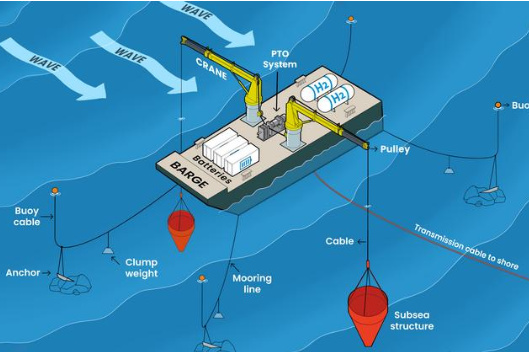
The system they studied uses the rolling motion of a floating barge to harvest energy. Upside-down cones hang below the water on both sides of the platform. These cones make the platform behave as if it were heavier and add resistance from the surrounding water. In simple terms, they change how the platform moves, helping it respond better to the long waves common in some coastal regions.
This could be especially useful for places such as the Galápagos Islands and other coastal or island communities, where clean and reliable energy is needed, but simple operation and maintenance also matter. In those settings, a technology with fewer control demands could offer practical advantages.
To test the concept, the researchers built a 1:40 scale model and carried out experiments in the wave tank at Davidson Laboratory at Stevens Institute of Technology. They tested one base case without cones and four additional cases with cones of different sizes and positions. Their goal was to see how the cones changed the platform’s stability, natural roll period, wave response, and energy capture.
The results showed that the cones clearly changed the behavior of the system. Most importantly, passive tuning increased the natural roll period to more than twice that of the barge without cones. In practical terms, this means the device can move closer to the rhythm of long swells, which are often harder to use with conventional technologies.
The tests also showed that adding the cones did not reduce the platform’s stability. At the same time, the cones increased water resistance. This is important because the design must strike a balance: it needs to respond well to the waves without losing too much energy through dissipation.
Among the cases tested, the best-performing configuration reached a Capture Width Ratio of 52% in regular waves, a strong result for this type of technology. In irregular waves, which better represent real ocean conditions, the same configuration kept efficiencies close to 21.5%. This suggests that the concept works not only in ideal laboratory conditions, but also performs well when the sea is less predictable.
Many marine energy technologies perform well in controlled tests, but lose efficiency in more realistic sea states. In this study, the strong performance in irregular waves suggests that the concept remains effective under changing sea conditions.
Another important result is that this study provides experimental validation of the idea. The tests physically showed that passive tuning with submerged cones can change the system’s motion and improve its ability to capture wave energy.
The research does not yet present a finished commercial product, but it does point to a promising direction. Compared with systems that rely on sophisticated control strategies, this concept offers a simpler and potentially scalable design that may be better suited for places where reliability and easier maintenance are especially important.
The researchers say the next steps include improving the model by adding nonlinear effects, optimizing the cone shape, and developing a real power take-off system to validate energy conversion more fully. Even so, the current findings already send a clear message: passive submerged structures can help a wave energy device adapt better to the sea and improve its efficiency.
At a time when the energy transition requires solutions adapted to local conditions, this work offers a practical idea for making better use of wave energy. For coastal and island communities, where access to clean and reliable electricity can make a major difference, advances like this could contribute to a more sustainable energy future.