
The EIO Task Force, which forms part of the Office of the Assistant Secretary of the Army for Installations, Energy and Environment, will be fully operational by 15 September of this year and is described in the press statement as being “integral to the Army addressing rising energy security challenges, escalating fuel prices, and stricter federal mandates”.
“The Energy Initiatives Office Task Force will help the Army build resilience through renewable energy while streamlining our business practices so developers can invest in and build an economically viable, large-scale renewable energy infrastructure,” said McHugh, “To meet a goal of 25 percent renewable energy by 2025, the Army must use every opportunity to be energy efficient and draw power from alternative and/or renewable energy sources.”
The scale of renewable energy production the Army needs in order to provide enhanced energy security is estimated to require investment up to $7.1billion over the next 10 years. This level of investment is expected to generate 2.1 million megawatt hours of power annually for the Army.
The EIO Task Force will work within the Army to streamline existing acquisition processes and leverage industry for the execution of large-scale renewable and alternative energy projects on Army installations. Army installations currently are pursuing renewable energy infrastructure, but often lack needed expertise. The EIO Task Force will fill this expertise gap and provide resources focused on working with the private sector to execute large-scale renewable energy projects. This is expected to result in increased interest by project developers and improved financial options for the Army.
“Addressing our energy security needs is operationally necessary, fiscally prudent and vital to mission accomplishment,” McHugh said. Katherine Hammack, assistant secretary of the Army for installations, energy and environment added, “The Army must leverage opportunities in renewable energy, which will enhance energy security.”
Through the EIO Task Force, the Army is planning to conduct an aggressive outreach effort to attract and engage private industry to foster strategic and financial collaboration in support of the Army’s installation energy needs.
Boosting soldiers' energy independence
In addition to ramping up its large-scale renewable energy generation capacity, the Army is also working to equip its forces with renewable energy powered equipment that, says the Army, “give soldiers an edge on the battlefield”.
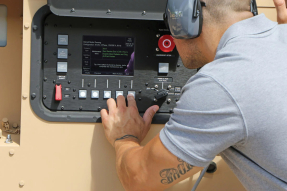
One of the top priorities of the US Army Communications-Electronics Research, Development and Engineering Center's (CEDEREC) Army Power Division is to provide soldiers with greater flexibility. It sees renewable energy as key to achieving this goal and is working to use more renewable energy in the field. The Army recently deployed the Rucksack Enhanced Portable Power System complete with solar panels for increased charging options, for instance.
According to Rafael Casanova, Battery Team Leader for the power division at CERDEC, said the center has received positive feedback on the packs from soldiers in the field. "They like to be able to recharge batteries right there where they are located," he said.
The power team has also developed a solar kit that consists of a solar panel and different adapters that allow soldiers to power any system. There are also fuel cell systems that can power radios and laptops, and the Army is set to evaluate a 300-watt fuel cell this November at Fort Riley, Kan., Casanova said. Other renewable energy programs in the works combine solar and wind power to generate up to two kilowatts of power. This reduces the amount of fuel needed and makes logistics planning simpler, Casanova added.
For additional information:
US Army Communications-Electronics Research, Development and Engineering Center