
The three replacement strategies evaluated are new diesel models running on renewable diesel (RD) made primarily from vegetable oils and animal fats, battery electric vehicles, and new compressed natural gas trucks running on renewable natural gas (RNG) made from organic waste.
Each has significant clean air and public health benefits, but the updated report found that spiking diesel prices this year have altered the cost-benefit calculations in favor of RNG. RD is becoming more widely available, and since it can be used in conventional diesel trucks, it has lower capex compared to electric or RNG trucks. But RD is generally priced at parity with fossil diesel, so RD prices rose sharply this year, shifting the cost of the fuel relative to RNG. RNG is used in compressed or liquefied natural gas (CNG/LNG) trucks; in fact it makes up 94% of natural gas used as vehicle fuel in the US today according to industry data.
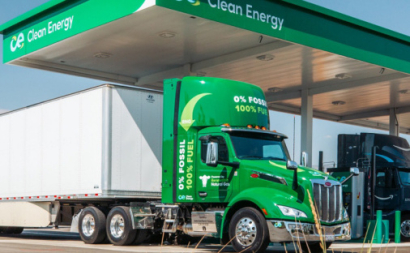
But unlike RD, RNG pricing is pegged to CNG which was mostly unaffected by the war. As fossil diesel and RD prices rose and RNG did not, RNG became much cheaper than diesel, currently costing around $3.50 less per gallon in California and $2 less per gallon nationwide. Switching from diesel to RNG still requires upfront capital expenditure of around $75,000 for a new CNG tractor trailer, such as models equipped with the high- performing Cummins X15N CNG engine.
That’s about a third more than comparable new diesel trucks cost. But given greater price differentials between diesel and RNG fuel, that additional capex could be recouped much faster than previously projected – somewhere between 1.3 years (if RNG costs $3.50 less per gallon than diesel) and 2.8 years (if RNG costs $2 less). After the initial payback period, RNG is the least expensive clean alternative to diesel for heavy-duty trucking.
Electric vehicles (EVs) remain the most expensive, since heavy-duty electric trucks cost two to three times as much as comparable diesel trucks. While rising diesel prices have made EV economics more attractive, cost, availability, and performance issues are still constraining mass adoption of heavy-duty electric trucks. The cost of building heavyduty charging infrastructure, interconnection queues from utilities already dealing with spiking electricity demand from data centers, and current regulatory headwinds pose additional barriers to wider adoption of EV heavy trucks. Of the 5.2 million Class 7 and 8 heavy trucks on the road in the US at the end of 2025, fewer than 3,000 were EVs, and their number is increasing by less than 1,000 a year.
The negative air quality and health impacts of diesel trucks and the relative health benefits of clean, non-petroleum alternatives make adopting clean fuel for heavy-duty trucks urgent. Diesel exhaust contains carcinogenic particulate matter and other harmful chemicals like nitrogen oxides (NOx) which contribute to smog and acid rain. The worst polluting vehicles are heavy-duty diesel trucks built before 2013.
In the original 2025 report, Energy Vision studied 31 counties including 10 densely populated metro areas, where some 130,000 of these aging, polluting trucks are in operation. Their exhaust poses health threats to the 77 million people who live there, including 16.7 million children, who are particularly at risk. The effects of diesel air pollutants are disproportionately felt in environmental justice communities with greater truck traffic and more warehouses.
Diesel-burning trucks also emit high levels of greenhouse gases. Switching to clean alternatives would reduce or eliminate these impacts, Energy Vision’s original report found. For example, new diesel trucks running on RD reduce the negative health impacts by 66% compared to fossil diesel.
Heavy-duty EVs have zero tailpipe emissions, which benefits communities where they operate. But their lifecycle emissions are not zero, since much of the power grid charging their batteries still runs on fossil fuels. They also emit non-exhaust particulate pollution from tire and road wear due to the heavy weight of their batteries.
And their commercial availability and rate of adoption remain highly constrained. CNG heavy-duty trucks, on the other hand, are widely available. 90,000 are already in commercial use in the U.S., and 94% of their fuel is RNG. RNG powered heavy-duty trucks cut emissions to near zero and have 88% of the health benefits of EVs, at a much lower cost. Energy Vision found that replacing the 130,000 oldest diesel trucks with new RNG models across the 31 highly populated counties it studies would prevent over 100 deaths, 230 hospital emergency room visits for respiratory issues, and the onset of asthma for more than 660 people each year, avoiding an average of $2 billion a year in avoided healthcare costs.
RNG has potentially the lowest lifecycle greenhouse gas emissions of any other clean alternative, because producing RNG captures and refines into fuel the methane biogases from decomposing organic wastes, which would otherwise get emitted into the atmosphere. Methane is a powerful greenhouse gas (86 times more powerful over 20 years than carbon dioxide). Reaching US RNG production potential of 10 billion DGEs (diesel gallon equivalents) would cut US methane emissions by 13.6%. When food waste or manure are used as feedstocks, RNG is “net carbon-negative” – meaning more greenhouse gas emissions are avoided by producing it than are emitted by burning it as fuel.