
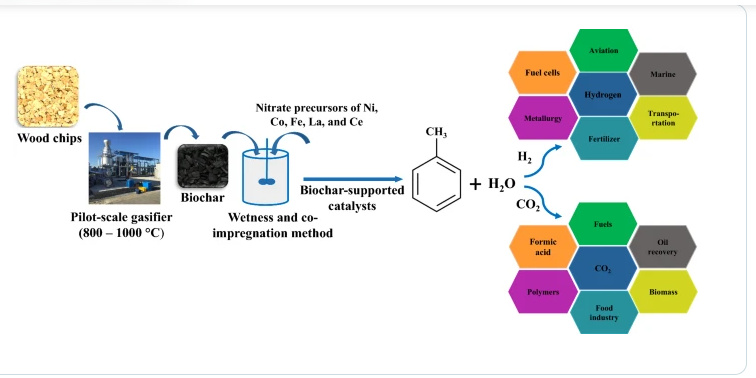
“Developing stable and efficient catalysts at low temperatures is essential for practical biomass utilization,” the authors explain. “Our findings show that biochar-supported catalysts can achieve high hydrogen yields while maintaining strong resistance to deactivation.”
Biomass gasification is widely regarded as a renewable route for producing energy. However, a major challenge lies in the formation of tar, a complex mixture of organic compounds that can clog equipment, reduce efficiency, and increase operational costs. Converting this tar into useful products such as hydrogen has long been a key goal for researchers.
In this study, researchers investigated a series of biochar-supported metal catalysts using toluene as a representative tar compound. Biochar derived from wood chip gasification was used as a low-cost and sustainable support material. Nickel, cobalt, and iron were first tested as active metals, with nickel-based catalysts showing superior performance in breaking down tar compounds.
To further improve efficiency, the team introduced lanthanum and cerium as promoter elements. These modified catalysts significantly enhanced catalytic activity by improving metal dispersion, increasing surface basicity, and creating oxygen vacancies that facilitate chemical reactions.
Among the tested materials, a lanthanum-promoted nickel biochar catalyst demonstrated the best performance. At just 400 °C, it achieved a hydrogen yield of 87 percent and a tar conversion rate of 93 percent. These results are notable because conventional tar reforming processes typically require much higher temperatures to reach similar efficiencies.
The improved performance is linked to several key structural features. The catalyst exhibited small and uniformly dispersed nickel particles, high basicity, and a large number of oxygen vacancies. These properties enhance the adsorption and activation of water molecules and promote the removal of carbon deposits that would otherwise deactivate the catalyst.
Durability tests further highlighted the advantages of the new material. While conventional catalysts showed rapid declines in performance, the lanthanum-modified biochar catalyst maintained stable hydrogen production over extended operation. Its ability to balance carbon formation and removal helped preserve active sites and sustain catalytic activity.
The study also explored how reaction conditions influence performance. Increasing the steam-to-carbon ratio improved hydrogen production up to an optimal level, while excessive steam reduced efficiency by blocking active sites. Similarly, lower gas flow rates allowed longer contact between reactants and the catalyst, leading to higher conversion.
Importantly, the use of biochar as a catalyst support offers additional environmental benefits. Biochar is produced from biomass residues and is both inexpensive and carbon-rich, aligning with circular economy principles. Its porous structure and surface chemistry make it particularly suitable for hosting active metal particles.
By combining renewable materials with advanced catalyst design, this research provides a scalable strategy for improving biomass gasification systems. The ability to efficiently convert tar into hydrogen at lower temperatures could reduce energy consumption and operational costs, bringing hydrogen production from biomass closer to real-world applications.
The findings highlight the potential of biochar-based catalysts as a sustainable solution for clean energy generation and waste valorization, supporting global efforts to transition toward low-carbon technologies.
===
Journal Reference: Zulqarnain, Kim, S., Chun, D. et al. Low-temperature steam reforming of toluene as a biomass tar model compound over biochar-supported catalysts. Biochar 7, 42 (2025).
https://doi.org/10.1007/s42773-025-00437-3
===
PHOTO CREDIT: Credit: Zulqarnain, Soohyun Kim, Donghyuk Chun, Jiho Yoo, Sang Jun Yoon, Seong-Ju Kim & Sung-Jin Park