
As production volumes increase, equipment capacity, energy consumption, maintenance requirements and plant layout all have a greater impact on the cost of every ton produced. For large-scale biomass plants, pellet mill selection therefore becomes an important part of the overall plant economics. This is particularly relevant in major biomass exporting regions such as Vietnam, where producers are supplying increasingly demanding international markets.
For Tây Sơn Biomass (TSB Group), capacity and consistency are already critical. The Vietnamese wood pellet producer has a long-term offtake contract with a Japanese power-generation company, requiring regular, high-volume shipments while maintaining the required pellet quality.
As Bui Tuan Anh (Andy), CEO of TSB Group, explains, “There are not many companies that can satisfy long-term offtake contracts at this level of supply, and these volume and quality levels can only be achieved if you invest in the right sort of equipment.”
Capacity changes the equation
When production targets rise, the capacity of each pellet mill starts to influence much more than throughput.
A higher-capacity pellet mill can reduce the number of units needed to reach the same overall production target. For producers planning a new plant or expanding an existing one, this can simplify the overall installation and reduce the amount of equipment that needs to be integrated, operated and maintained.
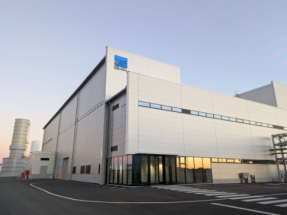
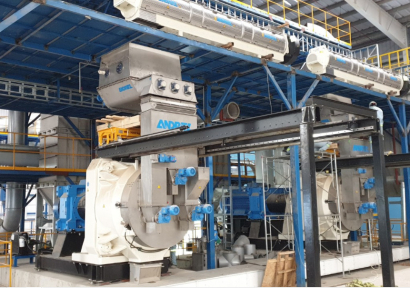
At its new greenfield biomass facility, Tây Sơn Biomass installed two ANDRITZ BioMax pellet mills alongside two wet grinders and two fine grinders supplied by ANDRITZ. The company is already planning to add a third BioMax as production develops.
And the capacity difference has been significant.
“Other suppliers were offering outputs of between six and seven tons per hour,” says Bui Tuan Anh (Andy), “but the BioMax pellet mill from ANDRITZ has proven to give us 11 to 12 tons per hour.”
For a high-volume producer, the difference between six or seven tons and 11 or 12 tons per hour quickly adds up. The initial price of the equipment is only part of the equation. What matters over time is how much capacity that investment delivers, and what it costs to produce each ton.
More than tons per hour
Output alone does not determine whether a pellet mill is economical.
Energy consumption, reliability, maintenance and wear all contribute to operating costs over the lifetime of the equipment. A high-capacity machine therefore also needs to deliver that output efficiently and consistently.
This is why looking at the purchase price alone can be misleading. Higher output from each pellet mill can help make better use of the initial investment, while low-specific energy consumption supports lower operating costs per ton. At industrial production volumes, even relatively small efficiency improvements can make a difference when multiplied across continuous production.
BioMax was developed specifically for biomass applications requiring high working loads and high volumes. Its pelleting chamber is combined with a stand-alone gearbox, while the patented infeed system uses three separate inlet screws to distribute material directly into the nip between the rolls and die. This provides more even material distribution and supports energy-efficient production.
For Tây Sơn Biomass, the result is not just higher throughput. The company also reports lower energy consumption, low maintenance, and high reliability from the installation.
Quality cannot get lost in the push for output
Anyone can talk about producing more. The challenge is producing more without losing control of the final product.
For Tây Sơn Biomass, this is particularly important because the company is not supplying a single market. Alongside its existing long-term Japanese contract, it is beginning to export to Europe, where ENplus A1 and A2 requirements are influencing its choice of equipment suppliers.
Raw materials add another layer of complexity. Biomass properties vary, so pelleting equipment has to work with the material available to the plant rather than under ideal laboratory conditions.
ANDRITZ tailored the dies used at the Tây Sơn Biomass plant to suit its local raw materials, following the same approach at other TSB sites in Vietnam.
The BioMax infeed system also plays a role here. Consistent material distribution across the die supports stable production rather than simply pushing more material through the machine.
Hydraulic roll adjustment adds another level of control, allowing the rolls to be positioned precisely as operating conditions change. Together, these features help maintain consistent pelleting conditions as production rates increase.
A pellet mill does not operate in isolation
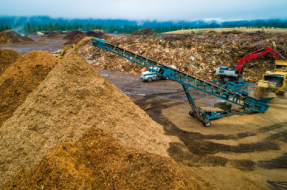
A pellet mill can only work with the material it receives. At Tây Sơn Biomass, chipped raw material passes through wet grinding, drying and fine grinding before it reaches the BioMax pellet mills.
For high-capacity pelleting, these upstream stages need to keep pace with the pellet mill. Otherwise, the benefit of greater pelleting capacity can be lost elsewhere in the line.
Getting more from the plant
Ultimately, it comes down to getting more from each pellet mill, without compromising on quality or adding unnecessary cost.
For producers looking to increase capacity, the question is not simply: “How many pellet mills do we need?”
But: “How much can we get from each one?”