
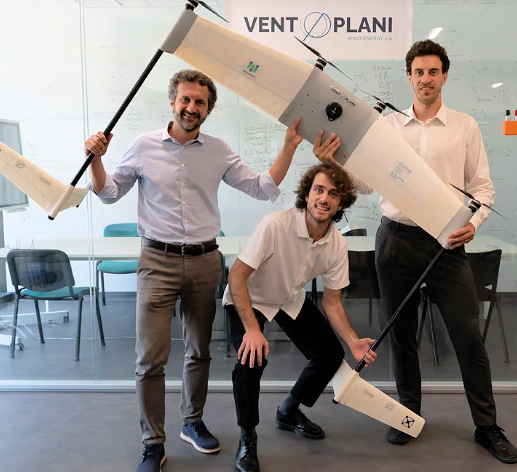
Windplanes are fixed-wing airborne wind energy systems that harvest wind power using small onboard turbines. Lightweight and fully autonomous, they are tethered to the ground, like a kite.
Windplanes generate electricity by flying in fast crosswind loops, with the onboard turbines generating the electric power.
By operating at higher altitudes, they access stronger and more consistent winds than conventional small wind turbines.
Their circular flight path sweeps a much larger area than a conventional rotor of similar size, increasing energy capture potential.
The tether transfers the aerodynamic forces to a lightweight ground station that manages launch, landing, and power systems.
For the same power output, windplanes can use less than 10% of the material required by tower-based turbines, making them a compact and scalable solution for distributed clean energy.
Their high capacity factor pairs well with solar and batteries, cutting the storage needed to keep hybrid systems running. Fast to deploy, even by autonomous flight, windplanes are also well suited to disaster relief and other temporary applications.
Farms, businesses, but also private homeowners and entire communities can be powered by windplanes.
By generating clean electricity, on-site or nearby, this technology cuts down on energy costs, and lowers grid-dependence, accelerating the transition to net-zero.
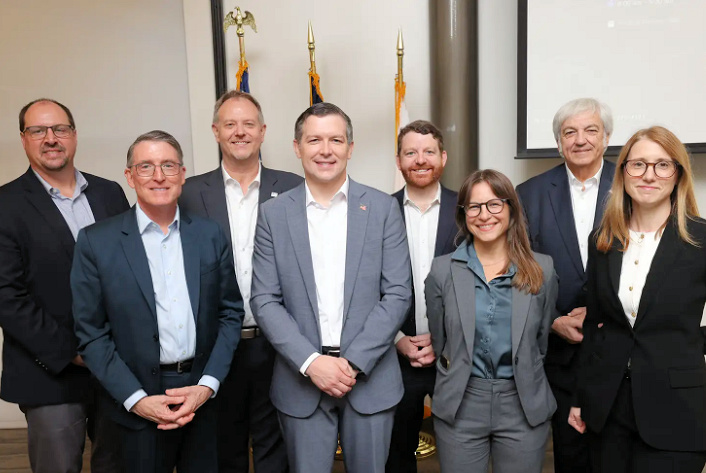
Ventoplani was founded by Filippo Trevisi (CEO), Prof. Lorenzo Fagiano (CSO), and Leonardo Cecchin (COO), all researchers at SAS-Lab, Politecnico di Milano.
Trevisi holds a PhD in Aerospace Engineering from Politecnico di Milano with thesis "Conceptual design of windplanes," whose breakthrough was certified by both academia and industry: he received the Excellent Young Wind Doctor Award from the European Academy of Wind Energy in 2025, and the Eni Award 2026 Young Researcher of the Year.
Fagianoholds a PhD in Information and System Engineering from Politecnico di Torino. He is Full Professor of Automation and Control Engineering and head of SAS-Lab, and has been principal investigator of close to ten research projects and contracts on airborne wind energy over the past fifteen years, co-authoring three patents and more than 50 publications on the technology. His research on airborne wind energy systems has been recognized with the Eni Award "Debut in Research" Prize (2010), the European Control Award (2019), and the Mission Innovation Champion Award for Italy (2019).
Cecchinholds a PhD in Microsystems Engineering from the University of Freiburg, earned within the Marie Skłodowska-Curie ELO-X doctoral network, has vast experience in prototyping and controlling drones and gliders, and leads SAS-Lab's experimental activities.