

The Offshore Wind Energy Market encompasses the development, construction, operation, and maintenance of wind farms situated in marine environments, including turbines, substructures, electrical infrastructure, installation services, and long-term operations. This renewable energy segment has emerged as a critical component of global decarbonization strategies, offering high-capacity-factor generation with the scale necessary to meet ambitious climate targets.
Two catalysts anchor that trajectory. The European Union's REPowerEU framework locked in a 2030 target exceeding 110 GW of installed offshore capacity, while the U.S. Inflation Reduction Act extended investment tax credits worth up to 30% of qualifying project capital cost through 2032 .
Neither is aspirational language; both translate directly into signed power purchase agreements and steel in the water. The Offshore Wind Energy Market therefore behaves less like a speculative clean-tech segment and more like regulated infrastructure with a visible order book. Global investment in offshore wind reached approximately $78 billion in 2024, with floating platforms absorbing a rising share of engineering spend.
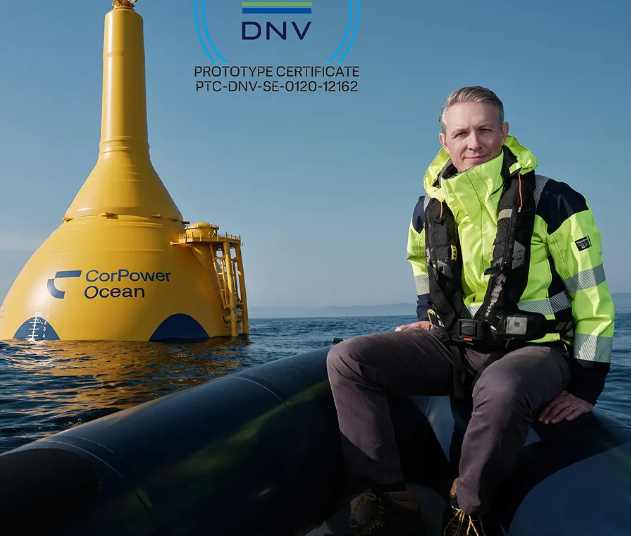
A fundamental technology transition is reshaping the Offshore Wind Energy Market. Turbine platforms have changed underneath the industry. Fixed-bottom monopiles carrying 6–8 MW machines — the workhorse of 2015–2020 — are giving way to 15–18 MW direct-drive units and, increasingly, semi-submersible floating substructures capable of operating in water beyond 60 meters. This generational leap in turbine capacity significantly reduces levelized cost of energy (LCOE), with IRENA reporting that global weighted-average LCOE for offshore wind fell 34% between 2010 and 2023, and further reductions are expected as larger turbines and floating technologies achieve commercial scale.
Policy and regulatory influence continues to shape the Offshore Wind Energy Market. Governments are now issuing contracts instead of targets. The UK's Contracts for Difference Allocation Round de-risks over GBP 20 billion of committed capital over recent rounds by guaranteeing strike prices linked to inflation over 15-year terms.
Japan's Sea Area Utilization Act grants 30-year occupancy rights at auctions, making project financing bankable at commercial spreads. The U.S. Bureau of Ocean Energy Management (BOEM) completed the Central Atlantic lease auction in February 2024, expanding federally leased acreage available for future solicitations.
The demand outlook for the Offshore Wind Energy Market remains exceptionally strong. Europe still commands 46.5% of global value, built on three decades of North Sea learning curves. Asia-Pacific grows fastest at 13.6% annually as China, Taiwan, Japan and South Korea convert auction pipelines into construction. North America ranks third, propelled by state-level procurement mandates in New York, New Jersey and Massachusetts. The market is projected to reach $108.1 billion by 2030 and $189.7 billion by 2035, driven by policy mandates, corporate offtake, and grid investment that removes binding constraints on project development.
Regional Analysis
Europe
Europe commands 46.5% of the Offshore Wind Energy Market, built on three decades of North Sea operations that produced standardised consenting, mature O&M ports and a service vessel fleet that no other region matches. The United Kingdom leads with 31.5% of regional share, driven by Contracts for Difference allocation rounds that guarantee strike prices linked to inflation.
Germany follows with 22.0% share, targeting 70 GW by 2045 through statutory mandates. The Netherlands contributes 15.5% through tender-based zero-subsidy awards, while Denmark's 9.0% share is driven by energy island development. Poland's Baltic program and France's Atlantic tenders now extend that base geographically, representing the most significant near-term capacity additions in Eastern and Southern Europe.
Asia-Pacific
Asia-Pacific is the fastest-growing region in the Offshore Wind Energy Market, expanding at 13.6% CAGR as auction pipelines convert to construction. China alone commissions more offshore capacity annually than the rest of the world combined, with provincial capacity allocation driving 2025 value of $17.2 billion, supported by a vertically integrated domestic supply chain that has driven turbine prices well below Western benchmarks.
Taiwan follows with $2.4 billion through Round 3 grid connection awards, pioneering localisation mandates that seeded an Asian component base. Japan's Sea Area Utilisation Act auctions generated $1.9 billion in 2025, with typhoon and seismic conditions demanding engineering variants unavailable in European catalogues. South Korea and the Rest of Asia-Pacific (including Vietnam and India) contribute through Renewable Portfolio Standard obligations and early-stage pipelines respectively.
North America
North America contributes roughly $8.1 billion to the Offshore Wind Energy Market, growing from a small base and depending heavily on state-level procurement holding firm through federal policy shifts. The United States leads with a 15.4% CAGR through 2035, driven by state offtake solicitations and tax credits under the Inflation Reduction Act.
New York, New Jersey, Massachusetts, and Maryland have collectively contracted several gigawatts, and port investments at New Bedford and Portsmouth create the staging capacity that earlier rounds lacked. Canada's Nova Scotia licensing framework targets 5 GW of offering by 2030, while Mexico proceeds with early feasibility assessment.
Rest of the World
South America and the Middle East & Africa represent smaller but emerging segments of the Offshore Wind Energy Market. Brazil dominates South American demand with 78% of regional share, driven by the 2025 offshore regulatory framework that resolved the tenure question that had frozen dozens of environmental applications
Hydrogen export ambitions to Europe give several proposed projects a second revenue thesis beyond domestic power sales. Morocco leads the MEA region with a 17.5% CAGR through 2035, driven by European export interconnection studies, while South Africa and the Rest of MEA evaluate offshore capacity primarily for desalination power coupling and coastal resource mapping.