
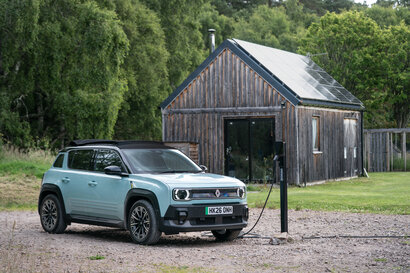
Timed to coincide with the longest days of the year, the five-day, 1,000-mile journey saw a Renault 4 E-Tech electric plein sud techno+ travel north through Britain using energy generated entirely by the sun.
No electricity from the grid was used to power the vehicle during the record journey, with the Renault instead charged using a three-phase Easee Charge Pro EV charger connected to a combination of established solar arrays and portable, solar-charged battery storage units through the journey’s route.
Bringing together renewable generation, mobile energy storage, intelligent EV charging and a standard production electric vehicle, the Easee Sun Run showcased what can already be achieved when clean-energy technologies work to deliver truly sustainable mobility.
"The Easee Sun Run goes a long way to showing what clean mobility is capable of today” said Anthony Fernandez, CEO of Easee. “In connecting electric vehicles, renewable generation and energy storage into one flexible ecosystem that works together efficiently, clean transport can become more resilient and more accessible. Many of the technologies needed to deliver that are already here, and they're in action today – from intelligent home charging to scalable, business-ready solutions that help fleets make the switch. The journey we've just completed may be poetic, but it's squarely grounded in the reality of smart, clean technology available to consumers and businesses now.”
The Renault 4 E-Tech electric plein sud techno+ represented a fitting choice for the unprecedented challenge, its name translating as ‘due south’, the optimal direction for solar panels in the northern hemisphere to capture energy from the sun.
The fully electric Renault 4 combines a 52kWh battery and 150hp powertrain with a driving range of up to 242 miles under the WLTP combined cycle. The plein sud version also features an electrically operated canvas sunroof, providing a modern homage to earlier Renault 4 generations’ distinctively open-air character.
At journey’s start close to Land’s End, the Renault 4 plein sud and one of the larger portable storage units were charged using fully solar energy, readying the vehicle for its expedition north. As the car travelled northward, further energy was supplied through a carefully coordinated network of solar installations and pre-charged mobile battery units.
Rather than focusing solely on reaching the finish line, the Easee Sun Run explored the people and projects helping to shape the UK’s solar-energy story.
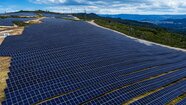
Along the way, the team marked the summer solstice near Stonehenge and charged up at the UK’s first commercial solar farm in Chard, Somerset, before revealing how an off-grid solar system has helped turn rural Derbyshire’s Whaley Bridge Cricket Club into a community hub.
The journey went on to explore the next generation of flexible, rollable solar materials at Swansea University in Wales, subsequently shining a spotlight on Durham University researchers’ work in delivering an ultra-efficient vehicle capable of racing on energy generated directly from the sun.
In Scotland, an extraordinarily evocative solar pyramid south of Edinburgh played host to the expedition, demonstrating how rapidly photovoltaic technology has progressed. The journey proceeded north to the starkly beautiful and remote coastline of Dunrobin – where, in the grounds of Dunrobin Castle, a further vote of confidence in the remarkable technology was placed, with residents using renewable solar generation and battery storage to support their off-grid living and business operations.
These eclectic stories came together to collectively illustrate the wide-ranging role of solar energy in supporting homes and local communities, while simultaneously powering commercial fleets, scientific innovation and long-distance electric travel.
Easee’s smart charging technology is designed to work with renewable-energy systems by adapting vehicle charging to the power available. Its solar charging ecosystem can track energy production and adjust charging accordingly, helping drivers make greater use of locally generated renewable electricity.
The Easee Sun Run builds on its previous solar-powered charging project in Canada’s Northwest Territories. Conducted during challenging sub-Arctic winter conditions, that pilot demonstrated how portable solar generation, battery storage and smart charging could support electric mobility beyond conventional grid infrastructure.
By completing a full journey from Land’s End to John O’Groats, Easee and Renault have now demonstrated the same principle over an extended, real-world drive in a standard production vehicle, making better use of clean electricity whenever, and wherever, it’s available.
For additional information: