
CEO Carlos Araque calls the technology involved “the first drilling innovation in 100 years.” He believes that it could allow the world to access superhot, superdeep clean, renewable geothermal energy—the heat beneath our feet—on a scale equal to fossil fuels.
Live Drilling, Tours
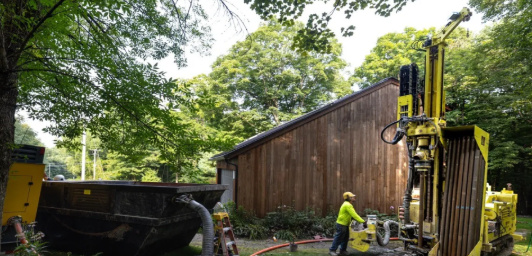
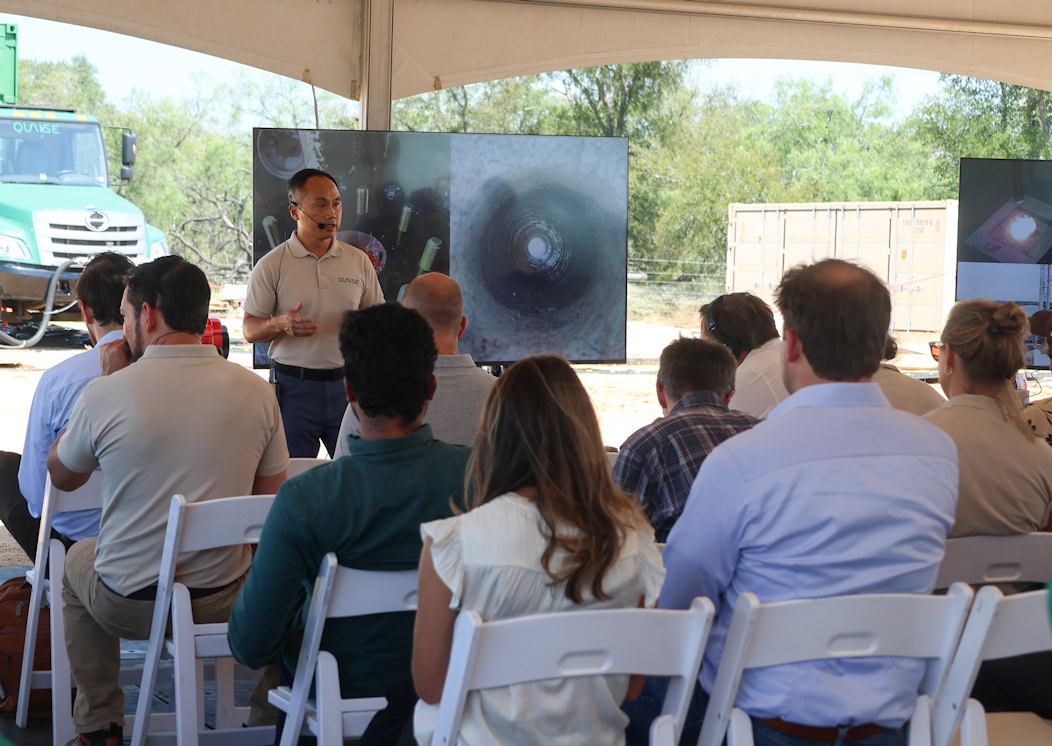
At the Sept. 4 event, some 56 observers braved 99-degree heat to not only watch the drilling process in action—complete with real-time data projected on a flat-screen TV—but also tour four stations related to the work.
Steve Jeske, a Quaise project manager, emceed the live drilling operation, which also included live footage of the growing hole itself. He acknowledged that there really wasn’t much to see.
Why? “Because drilling, when it’s done well, is very boring. And that’s a very, very good thing. It means it’s very safe.”
Stops on the tour that followed the demo included the drilling rig, which resembled a small derrick; the trailer holding the gyrotron, which produces the energy—millimeter waves—used for drilling; and the driller’s cabin, also known as the doghouse, where a small crew controls the entire process.
At the final station, attendees peered down the record-setting hole the company completed in July. A live video camera threaded down the hole facilitated the observations, which showed a uniform hole transition from surface soil to granite.
At some 118 meters, the hole is the deepest ever drilled with millimeter-waves, which are similar to the microwaves we cook with. Millimeter waves are powerful enough to ablate the pink granite at the Marble Falls, Texas, demonstration site into a grey ash, samples of which were available on the tour.
In a video released the day of the demonstration, Matt Houde, co-founder of the company with Araque and Chief of Staff, said, “At Quaise, we’re rapidly moving from microwaves in the ground to megawatts on the grid.”
Said Araque at the demo, “Quaise is not a drilling company, it’s an energy company. We aim to make geothermal the workhorse of the energy transition, and we won’t stop until we succeed.”
Progressively Challenging Demonstrations
The Marble Falls demonstration in July was the latest of several progressively challenging demonstrations over the past year showing the company’s progress.
According to Justin Lamb, head of field operations at Marble Falls, “Last fall we started by drilling four feet into a granite core inside our Houston lab. Then we moved right outside the lab to drill ten feet into another granite core.”
In May of this year the company drilled 40 feet into a granite core on a full-scale oil rig just outside of Houston owned by Nabors, one of the world’s largest oil-and-gas drilling companies.
For Lamb, the July demonstration “was a critical moment. Could we make this work out in the field?”
All of the previous demos had been conducted under controlled experimental conditions.
The answer was yes. “We were able to drill that 118 meter hole on our first try,” Lamb said. “It’s been highly successful, beyond all of our best hopes.”
The Marble Falls demonstration also had other positive results. For example, even though the team wasn’t overly concerned with the drilling rate—“we started slow to make sure it worked,” Lamb said—they still showed that they can drill at a rate of up to five meters per hour through some of the hardest rock in the world. “That’s extremely fast,” Lamb said.
Henry Phan, Vice President of Engineering at Quaise, explained that today’s commercial operations average a drilling rate of a tenth of a meter per hour through granite. Quaise’s long-term goal is to drill at a continuous rate of penetration, regardless of rock hardness and depth.
Phan went on to note that the hole diameter at Marble Falls was four inches. “Our production goal is eight and a half inches.”
Marble Falls was also important because “it allowed us to test and validate what our engineers have been modeling for a few years, and the data are matching up really well, which is quite exciting,” said Emilie Williams, Test Group Manager at Quaise and one of four tour guides at the demonstration along with Houde, Phan, and Jeske.
What’s Next?
According to Araque, it aims to break its own drilling record by drilling 10 times as deep, to one kilometer. This could take place within the next few months.
In the meantime, the Quaise team is working to optimize the entire process through additional tests.
“We’ll experiment with various parameters to, for example, control how straight the hole is and see if we can go even faster,” Williams said.
The company is hosting six more public demonstrations at the Marble Falls quarry over the next three months.
By By Elizabeth A. Thomson, Correspondent for Quaise Energy