
Dr Johnstone continues to collaborate with the team of university earth scientists working on geothermal energy projects. Using legacy data and cutting-edge 3D mapping of disused coalmines, on top of which a quarter of all current UK housing stock is built, the team has modelled a concept for unlocking the Earth’s heat from the floodwater.
The method of pumping it to the surface to extract the thermal energy has already been developed in Gateshead (UK) where it supplies heat to a mixture of commercial and domestic buildings including Gateshead College and the Baltic Centre for Contemporary Art. The researchers now believe it can make a major contribution to entire nations’ energy transition targets.
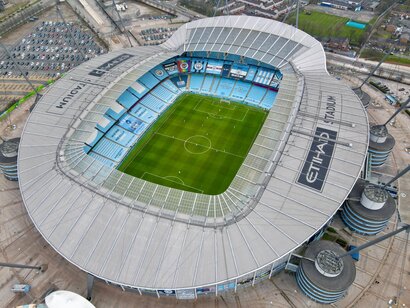
Focusing initially on the former Bradford Colliery in East Manchester, less than 1 kilometre directly beneath SportCity, the team have identified seams of mine water with a calculated supply rate of 2.3 MW, or enough to heat up to 2,000 houses on that site alone.
“This project is of national significance, given the scale of the renewable energy sources accessible” said Dr Johnstone. “Our concept involves using legacy mine plans from the Mining Remediation Authority and sub-surface sensing technology, similar to that employed on a larger scale by Metatek, to identify suitable locations to extract naturally heated mine water from deeper seams, and reinject it into shallower ones, creating a circuit of sustainable thermal energy and replacing the need for fossil fuel heating. As a next step we look forward to presenting our study to some of the high-profile occupants of the area. Some globally recognised brands in sport, retail and entertainment occupy premises on the site we have mapped, and we are excited to share with them these new ideas for offsetting some or all of their current energy requirements.”
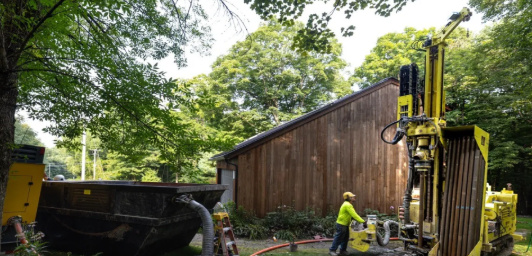
Heat networks such as the one modelled by David Johnstone and team would require an abstractor well to a depth of approximately 500 metres, and a “reinjection well” to little more than 100 metres.
The above-ground infrastructure related to boreholes requires an area equivalent to a tennis court, whilst the heat exchangers and industrial heat pumps require a small warehouse unit.
The Gateshead scheme took three years to implement and is expected to save 72,000 tonnes of CO₂ over 40 years. This would mean every area of the UK that is built above former coalmines could be accessing its own, clean energy after a payback time of just 10-20 years.
For additional information: