
Technical advancements
As the project has now surpassed the first third of its planned duration, notable progress has been made in several areas, while certain challenges have also emerged. One of the most significant difficulties arose from the unexpected bankruptcy and liquidation of Universal Hydrogen, one of the consortium's key industrial partners. However, the partners responded proactively ensuring continuity and safeguarding the project's objectives for the coming years.
In terms of technical progress, the first 18 months have been steady advances. The Work
Package on technical specifications and techno-economic boundary conditions, led by Piaggio Aerospace, is nearly completed. This achievement included the successful delivery of three out of its four primary tasks, such as the pre-analysis of refueling concepts and the detailed modeling of hydrogen demand for both direct refueling and tank-swapping technologies at airports in Paris and Milan.
The completion of Milestone 2 confirmed the robustness of these pre-analyses, while the team also demonstrated strong problem-solving skills in overcoming challenges linked to the complexity and volume of hydrogen demand data required for the final analysis.
Further progress has been recorded in the development of liquid hydrogen supply and accelerated loading systems. Preliminary NPSH analyzes and HAZOP studies have been performed. The pump design is being finalized, and subsystem modeling is underway, with initial results proving highly promising. In parallel, advances in direct refueling technologies have also been achieved, particularly in the identification and testing of sensors, in the design of the LH₂ tank and positioning of the integrated sensors, in the development of the digital twin, and the creation of preliminary CFD and FEA models.
The project has also moved forward with its demonstration activities and technological evaluation. Preparations for the direct refueling demonstration at Malpensa Airport have now begun, involving the definition of requirements and objectives, the elaboration of a detailed test matrix, and the specification of the necessary demonstration hardware. The creation of both conceptual and physical schematics has provided a clearer framework for implementation, while also clarifying each partner's contributions and responsibilities.
At the same time, work on environmental, safety, regulatory and cross-cutting aspects has progressed steadily, with the completion of an initial regulatory screening, the identification of Sandbox procedure documents, and the launch of preliminary hazard identification and safety modeling. Furthermore, a Virtual Reality environment and a 3D airport model have been developed to support training activities, reinforcing the project's holistic approach to safety and regulation.
The journey ahead
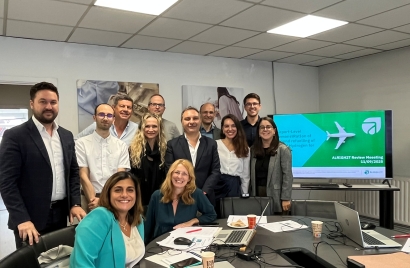
This meeting represented a key gathering for the ALRIGH2T Project, underlining the importance of collaboration across all consortium partners. Despite external challenges, the project has laid strong foundations for its continued success.
As it advances, ALRIGH2T remains firmly committed to contributing to the decarbonization of aviation by developing cutting-edge liquid hydrogen refueling technologies and processes. In doing so, the project supports Europe's ambition to accelerate the energy transition and to pave the way towards a more sustainable future for air transport.