
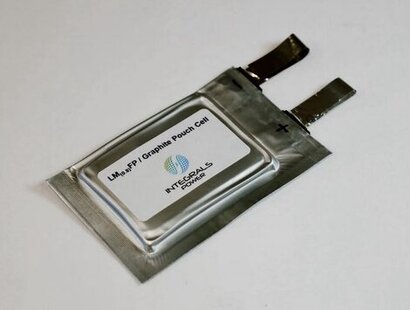
The funding will enable Integrals Power to undertake Project CATMAN: an assessment of scaling up UK production of its proprietary Lithium Iron Phosphate and advanced Lithium Manganese Iron Phosphate (LMFP) cathode active materials. This will validate and de-risk the manufacturing pathway from the current pilot line to a commercial-scale facility, with the aim of establishing the UK as a leading manufacturer of these strategically important materials. LFP and LMFP can be used in a wide range of applications, including electric vehicles, grid scale energy storage, marine, and defence, but almost all current production is based in China.
LMFP represents a significant advancement on conventional LFP, combining its inherent safety, relatively long cycle life, and cost-effectiveness with a 20 percent increase in energy density, achieved through an 80 percent manganese content. Unlike NMC, LMFP doesn’t use cobalt or nickel, reducing dependence on these expensive, critical raw materials, which improves sustainability, and reduces battery cost.
“Securing this funding from the APC is an important milestone for Integrals Power and for the UK's battery supply chain” said Integrals Power Founder and CEO, Behnam Hormozi. Project CATMAN will give us the detailed technical and commercial evidence we need to move confidently to the next stage of scale-up, and to unlock the investment required to build a 1,000 tonne per year facility in the UK. Our LMFP material has already proven itself in independent testing by QinetiQ – now we need to prove the manufacturing process at scale, and that is exactly what this programme will deliver. The UK has a genuine opportunity to establish manufacturing for these strategically important cell chemistries outside of China, and this funding is a critical step in enabling that to happen.”
The project will assess the feasibility of scaling Integrals Power's operations from its current 20 tonne/year pilot line – already capable of producing both LFP and LMFP cathodes – to a 100 tonne/ year demonstration facility, with full engineering readiness for a 1,000 tonne/ year commercial line. The programme will also engage directly with automotive, marine, and defence customers to understand their requirements of LMFP in larger cell formats including pouch and cylindrical.
Integrals Power’s LMFP’s performance credentials are well proven. Independent and on-going cycle life testing conducted by QinetiQ has already exceeded 1,500 charge and discharge cycles at a 1C rate with nearly 80 percent capacity retention, while cold temperature testing by Cranfield University has demonstrated 85 percent retained capacity at -25ºC and 68 percent at -30ºC – significantly outperforming current LFP and LMFP benchmarks. With a target production cost that is significantly lower than NMC and competitive with China, LMFP offers an optimal cell chemistry for a range of sectors.
The strategic importance of establishing domestic manufacturing capability for advanced cathode active materials has grown considerably following China's introduction last year of export restrictions on LFP and LMFP materials and manufacturing processes. With EU Battery passports coming into effect from 2027, and EU-UK rules of origin requirements for EV batteries tightening from 2027 – requiring 65 percent of cell value and 70 percent of battery pack value to originate in the UK or EU to avoid 10 percent tariffs – a localised supply chain is no longer simply a competitive advantage; it is fast-becoming a commercial and regulatory necessity. The DRIVE35 funding for Project CATMAN aims to ensure that Integrals Power can play a pivotal role in meeting those needs.
For additional information: