
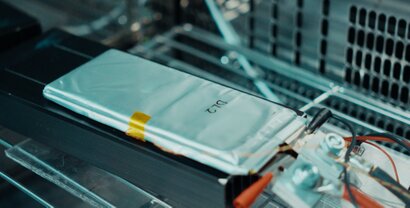
A previous high-temperature test found that the vacuum structure around the Donut Battery had broken and lost its vacuum. However, the battery cell used in the test utilised materials and adhesives borrowed from the lithium-ion battery industry, which are not designed to operate at temperatures of 100 degrees Celsius.
It was assumed that the battery had broken completely and gone into thermal runaway, which would be a likely outcome if it had been a lithium-ion battery. To demonstrate the battery’s safety in practice, Donut Lab decided to continue cycling the damaged battery cell.
“If a similar failure were to occur with a traditional lithium-ion battery, the consequences would be serious” said Ville Piippo, CTO at Donut Lab. “The liquid electrolyte would leak out, and the active materials would come into contact with oxygen, which could lead to a fire or thermal runaway. Lithium-ion batteries would no longer be able to operate after the vacuum structure breaks down. Because the Donut Battery is a completely solid-state battery, it is not susceptible to such reactions.”
The test used the same battery cell whose vacuum structure was damaged in the high-temperature test. This was not a battery life cycle test but rather a test to verify the Donut Battery’s ability to operate safely when damaged. In the test, the battery cell was first subjected to five standard 1C charge and discharge cycles. During these cycles, the battery cell operated completely normally and safely, even though its vacuum structure was broken.
The cell was then charged at a 5C fast charge rate for 50 cycles. During these cycles, the capacity of the battery cell stabilised at approximately 11 ampere-hours from the original 25 ampere-hours. However, it recovered slightly during the five 1C cycles at the end of the measurement. The key takeaway from this test is that, although the capacity starts to drop early due to the outer shell breaking, the cell operates consistently and safely without temperature spikes or fire risk.
“The test demonstrates that in this type of situation, the Donut Battery does not pose a danger to the user even when damaged” added Mr Piippo. “Instead of catching fire like a traditional lithium-ion battery in a similar situation, it continues to operate safely at a reduced capacity. This is a concrete demonstration of the safety benefits of our solid-state battery technology.”
For additional information: