
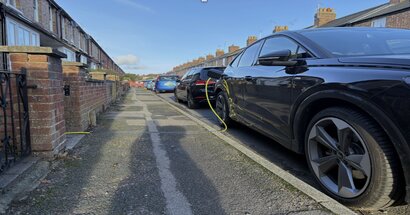
The UK Government has confirmed plans to make it simpler for people without driveways to charge an electric vehicle at home, removing the need for a separate planning application for approved cross-pavement charging solutions and associated home chargepoints.
The change, announced in the Government’s response to its consultation on EV charging rules, will create a new permitted development right for cross-pavement charging. Local authorities will continue to oversee installations through existing highways permissions and safety safeguards.
It could help tackle the UK’s growing “charging divide”, which leaves millions of people without off-street parking facing greater cost and bureaucracy if they want to charge an EV from their own home electricity supply.
Around four in ten UK households do not have off-street parking. Those drivers can otherwise be heavily reliant on public charging, which can cost up to ten times more than charging at home.
The announcement follows a campaign led by EVA England to make home charging fairer for drivers without driveways, working with Baroness Pidgeon and a wider coalition including the REA, New Automotive and Kerbo Charge.
During the passage of the Planning and Infrastructure Bill last year, Baroness Pidgeon tabled amendments seeking to remove barriers to cross-pavement charging, with support and briefing from EVA England and its partners. She subsequently secured a government commitment to consult on extending permitted development rights for home charging and then bring forward secondary legislation.
The announcement confirms that the Government will now proceed with the change, with work underway on the necessary legislation. It will also allow homes immediately adjoining the highway to install a cross-pavement solution and associated chargepoint.
“This is great news for drivers without a driveway, making it simpler, quicker and fairer for them to charge an EV at home” said Vicky Edmonds, CEO of EVA England. “People who park on the street should not face unnecessary extra hurdles just to access the cheaper and more convenient charging available to people with driveways. Removing the need for a separate planning application takes away one of those barriers. EVA England has worked hard to put this issue on the agenda, alongside Baroness Pidgeon and our partner organisations including the REA and New Automotive. Baroness Pidgeon secured the Government’s commitment to consult on this change during the Planning and Infrastructure Bill, so it is fantastic to see that commitment now turning into action.”
The Government has also announced changes intended to make it easier to build larger and higher-powered public charging sites. Existing planning rights will be expanded to allow multiple units of supporting equipment in non-domestic car parks, while the overall permitted volume will increase from 29m³ to 45m³.
The announcement came as EVA England’s annual Steer the Conversation survey opened, giving both EV drivers and petrol and diesel drivers the chance to say what is working, what is holding people back from switching, and what needs to change.
EVA England is encouraging drivers across the country to take part, with the findings set to help shape its recommendations to Government and industry.
For additional information: