
“If successfully developed, SHR could supply 63 terawatts of firm, carbon-free power by tapping just 1% of the world’s SHR resources – more than eight times current global electricity generation,” according to a recent report from the Clean Air Task Force.
Water pumped through small permeable cracks in such rock would become supercritical, a dense, steam-like phase that most people aren’t familiar with. (Familiar phases are liquid water, ice, and the vapor that makes clouds.) Supercritical water, which forms at about 374 degrees C (704 degrees F), can carry up to five times more energy than regular hot water, making it an extremely efficient energy source if it could be pumped above ground to turbines that convert it into electricity.
“We’re developing a flow-through reactor that allows us to move fluid through the same kinds of rock under superhot conditions while letting us look at how the systems change in real time,” says OSU Assistant Professor and Barrow Family Chair in Mineral Resource Geology Brian Tattitch. He leads the Experimental Deep Geothermal Energy (EDGE) lab in OSU’s College of Earth, Ocean, and Atmospheric Sciences.
“This research is critical because SHR geothermal operates in a regime where existing models fail, and only controlled flow-through experiments can generate reliable data on fluid behavior, scaling, and rock–fluid interactions needed to design durable wells and reservoirs. Quaise is supporting this research because early access to these data will materially reduce the technical and financial risk of developing our SHR geothermal power projects,” says Geoffrey Garrison, Vice President of Operations for Quaise.
he EDGE lab will have three general avenues of research, says Tattitch.
One involves how rock behaves under superhot, superdeep conditions. “How is it going to respond to hot fluids moving through it?” asks Tattitch. That’s complicated by the fact that the rock involved is not uniform. “There are different types of rock with different mineral compositions that in turn will react differently to fluid.”
For example, Tattitch continues, quartz, silica or other minerals could grow in the space that the fluid is trying to move through. These crystals could eventually block the pathway, restricting the fluid flow needed to keep energy moving to the surface. “We can simulate different scenarios in the lab and try to figure out whether or not the system is going to clog under those scenarios. And because we’re monitoring the chemistry, we can work to understand exactly what’s happening and apply that to monitoring real wells.”
In a second avenue of research, the EDGE lab aims to explore an important byproduct of the Quaise drilling technique: the vitrified glass-like liner that forms around the sides of a hole. That liner could prevent the hole from collapsing, among other advantages.
“We want to explore how that glassy material behaves under a variety of different conditions and time scales in the SHR environment,” says Tattitch.
Finally, the EDGE lab will be used to learn more about how other materials key to producing geothermal power react under SHR conditions. For example, a conventional geothermal system uses materials like sand to keep open the fractures that allow fluid movement. “The problem is that some of the things we use today may not behave very nicely at 400 degrees C,” says Tattitch. “We need to know what those materials are going to do.”
Tattitch and his team at OSU are excited about getting undergraduate and graduate students involved in the work.
“Right now, SHR is a frontier. Those students will go on to have careers in the field when it becomes a functional method for generating significant power.”
AUTHOR: Elizabeth A. Thomson, Correspondent
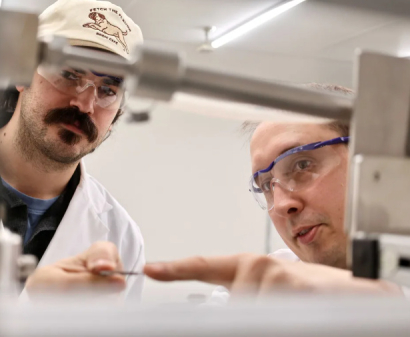
PHOTO: OSU Graduate Student Joe Clevenger (left) and Assistant Professor and Barrow Family Chair in Mineral Resource Geology Brian Tattitch stand next to the custom-made equipment in the Experimental Deep Geothermal Energy lab that Tattitch leads. Photo courtesy of Oregon State University.