
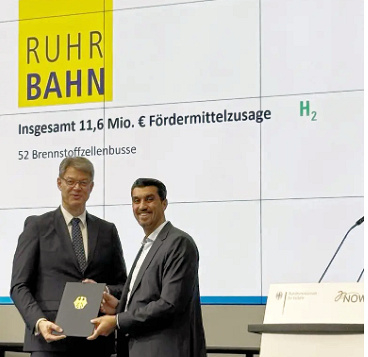
Federal Transport Minister Patrick Schnieder presented the funding certificates to transport companies from all over Germany.
“This sends a strong signal for our region,” Avsar emphasizes. “With the new hydrogen buses, we are consistently developing our mobility services – making them efficient, flexible, and future-proof. For our passengers, this primarily means reliable everyday mobility. We are also making a targeted investment in the future viability of the Ruhr region.”
Minister Patrick Schnieder, said, “With around €11.6 million in funding for 52 new hydrogen buses, we are strengthening modern and climate-friendly local public transport in the Ruhr region. Hydrogen offers long ranges, short refueling times, and great operational flexibility, especially in densely connected regions. That's why we are supporting transport companies in modernizing their fleets step by step – for clean mobility, economic strength, and reliable services for local residents.”
The 52 new solo fuel cell buses will gradually replace older diesel vehicles and will be deployed on various routes within the Ruhrbahn service area. Hydrogen buses offer long ranges, short refueling times, and greater operational flexibility. This makes them particularly suitable for a dense and diverse network of routes like those found in the Ruhr region.
At the same time, the vehicles impress with their smooth ride, high passenger capacity, and modern features. Thus, the new fleet generation combines innovative technology with tangible added value in daily operation.
A clear decision in favor of hydrogen forms the basis of the investment, following a comprehensive, updated analysis of the long-term direction of the bus fleet. Within the framework of the "H2 Zero Emission" project, battery and hydrogen drives were systematically compared.
The result: Under the given conditions at Ruhrbahn, fuel cell propulsion proved to be particularly suitable from an economic and organizational perspective on the majority of lines. In addition to cost considerations, range, operational flexibility, and capacity were decisive factors in the strategic decision.
Step by step towards a modern fleet
Nineteen hydrogen-powered buses have been in operation in the Ruhrbahn service area since 2025. A further seven hydrogen buses are expected to be delivered and put into service by the end of 2026.
With the 52 additional vehicles now being funded, the hydrogen fleet will grow to a total of 78 buses by 2027/2028. Ruhrbahn's bus fleet currently comprises a total of 315 solo and articulated buses.
The investment is part of a long-term modernization strategy. The aim is to further develop local public transport in Essen and Mülheim an der Ruhr technologically and to establish it as a reliable backbone of mobility in a strong metropolitan region.