
Can you give me some background about yourself and about Turboden
Turboden is a company established in the 80s by Professor [Mario] Gaia, a professor of energy and mechanical engineering, as a spin-off from University of Milano. In 2013, the company was part acquired by Mitsubishi Heavy Industries. Now Mitsubishi Heavy Industries, or MHI as we call it, owns 71 percent of the company.
We have a large global footprint in design, manufacturing and supplying ORC, Organic Rankine Cycle systems. We have more than 470 units worldwide in more than 52 countries. The headquarters is here in Italy, in the northern part of Italy. We have a manufacturing facility in Turkey, and we have a branch in Houston, Turboden America, as I mentioned.
We are also planning to establish some manufacturing capacity in the US as well. But this could be maybe in the second-half of the next year, if things are going as we expect. We employ almost 500 people.
Much more information is available on our website.
Can you explain what enhanced geothermal is and also what an Organic Rankine Cycle (ORC) turbine is?
Yeah, I’ll try to make this easy, although it is a tough question. Geothermal is one of the applications that Turboden typically supplies. ORC stands for Organic Rankine Cycle, which means that we spin the turbine by an organic vapour, which is not steam, it's not water, it is organic like we may use almost a dozen or even more of organic compounds like isopentane, cyclopentane, refrigerants and so forth. This allows the system to exploit heat sources at a low temperature.
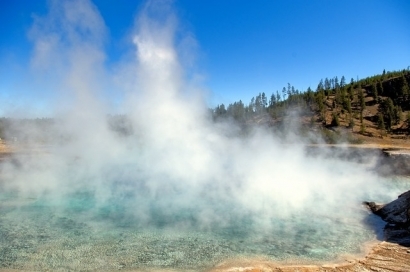
While the water is typically used at the higher temperatures, in geothermal, where the heat source is typically between 150 to 100 and more degrees, the ORC systems are the best solution, so we can exploit that heat source. We take the heat that has been taken from underground and we transform that into electricity by just vapourising the organic compound, and then the vapour spins the turbine. This is what we do - we do not actually extract the heat from the underground, an activity that is done directly by Fervo, because they have the technology, while our expertise is to convert that heat into useful power.
The same concept is applicable to any kind of heat sources, not only geothermal. If you have a waste heat from industrial processes, from the exhaust of gas turbines, from biomass, from incineration of waste, these are all applications that Turboden carries out.
We were approached by Fervo in 2022, when Fervo was just a startup. We supported them in their development with our analysis of the best solution, not only technically but also with regard to the business model, identifying the best solution. We supported them with a lot of engineering activities, and they confirmed to go ahead with the first contract in 2024 for three ORC units, 40 MW each. After a second contract in 2025 for the supply of an additional three identical GeoBlocks, 50 MW each the new framework agreement covers almost 2 GW for the next three years.
Can you tell me more about the turbine’s development and the process leading to working with Fervo Energy?
The framework agreement for 1.7 GW is a complete game changer for everyone, for Turboden, but also for Fervo. That includes the commitment to deliver by Turboden, and to buy by Fervo, up to thirty-five standard 50 MW GeoBlocks, in the next three years. It provides Turboden with a long Roadmap thanks to the visibility of the volumes required. We are in a position to start right now purchasing the long lead items for the turbines, and book the slots of production of our vendors.
So, with forward planning, the next year's production schedule makes things much easier from the financial point of view, but also from a technical point of view also, as the standardisation of the design makes easier and faster to repeat and implement identical projects.
Because we have the ability to plan what we will do in the next second-half of next year, this will allow both Turboden and Fervo to save time and money and to leverage the cost reduction by repeating identical projects with a series production approach that is completely new for this industry.
Where will the main demand for the produced electricity come from? Who will be the main customers?
Fervo is, of course, one of our major customers. As I mentioned, we have a large footprint, with different applications, not just geothermal.
In the US, geothermal demand is growing, due to a lot of power demand from AI. This means that there are a lot of customers requesting ORC, not only for geothermal, because we believe that data centres will represent a huge opportunity for Turboden with regard to power generation. Typically, data centres have their own power generation at their facility, generating their own power through a gas turbine. Open cycle gas turbines are very good at generating power, but they are not the most efficient. They have a lot of heat, this is released into the atmosphere from the stacks of those gas turbines. Turboden, with ORC, has the capacity to convert this exhaust, this waste heat, into useful power without burning any additional gas. Keep in mind that this may generate an additional 25 percent to 30 percent of additional power without any water consumption, without any fuel, without any emissions. It is emission-free, water-free and augments power generation by 30 percent.
So, if you have a 1 GW data centre generating power from a gas turbine, you can have 1.2, 1.3, gigawatts of power at the same cost, with the same gas consumption. As you can imagine, this is a complete game-changer. So, now the two major, let’s say, opportunities that we see in the US are both interconnected with AI.
One of them is geothermal, but you need to be in a specific location to harness that, where the hot rock is located. This is mainly in the western part of the US, such as Utah, California, Nevada.
The other major pillar is waste heat recovery from power generated by data centres, which could be anywhere and everywhere - Texas, Utah, Ohio, Pennsylvania, New York, everywhere.
I gather this will also help to stabilise a strained American power grid. Can you talk some more about that please?
You know, there is an interesting point that people often don’t think about. Waste heat is generated where heavy industry operates, and heavy industry is rarely in the cities. Cement plants are built next to the quarries, mines follow the ore body, and gas compressor stations are spread along pipelines that cross huge stretches of open land. So a large part of the industrial heat we can recover is actually produced in remote, rural areas, very often at what we call the “end of the line” of the grid.
And the communities living there are usually served by very long distribution lines, far from the main substations. This means voltage fluctuations, outages, and very little room to connect new loads. It affects everybody: families, schools, clinics, local businesses.
This is where the ORC becomes really interesting, because it turns this situation into an opportunity. We take heat that would otherwise be lost and convert it into electricity, continuously, without burning any additional fuel and without additional emissions. And we do it exactly where the grid is weakest.
So, what does that bring? First of all, power is generated close to where it is consumed, so you reduce losses and congestion on the lines. Then, it is stable baseload power, available practically all the time, which helps support the local network. It can also help utilities postpone expensive investments in new lines and substations. The plants run unattended, with very little maintenance, and with air cooling they don’t even need water. And finally, there is a real benefit for the local economy, because reliable power enables new activities and electrification.
And this is not theory. Along gas pipelines in North America, for example, ORC units recover heat from compressor turbines in remote regions and feed clean electricity into the local utility grid.
So, for me, waste heat recovery with ORC is not just an efficiency measure for industry. It is a clean, reliable, distributed resource that brings power exactly where the grid needs it most
How does this advance Turboden’s portfolio and reputation in the US and globally?
Well, I think it fits very naturally into who we are. Turboden is a global company. We have been working for decades in very different markets, in Europe, in Asia, in the Americas, and each one of them has its own rules, its own grid conditions, its own regulatory framework and, of course, its own customer needs. Over time, this has given us something I consider very valuable: the ability to really understand a market and to shape our solutions around it, rather than simply offering a standard product.
The US is a perfect example. It is a large and diverse power market, with very different situations from one state to another, and with a strong need today for reliable, clean and distributed generation. Projects like these show that our technology can address those needs concretely, and that strengthens our reputation not only here, but globally, because what we learn in one market we bring to the others.
Then there is another important element. We are part of the Mitsubishi Heavy Industries group, and here in the US we work in close collaboration with our sister companies. This means we are not just a supplier of an ORC unit. Together, we can offer integrated power solutions, combining different technologies, engineering capabilities and the solidity of a major industrial group. For our customers, that means one reliable partner for complex energy projects.
So, in short, I would say this positions Turboden, within MHI, as a prime supplier of integrated power solutions, in the US and around the world.
What does the next 5-10 years look like for you with regard to Turboden’s development and growth?
That’s a good question. We at Turboden don’t focus on a single application – we have the capability to balance our portfolio of products, not only the ORC system, but also large heat pumps. We can even do the reverse, using electricity to generate heat, which is something that here specifically in Europe is a new trend. We have the application not only for geothermal but also biomass, waste-to-energy, large heat pumps, as I mentioned, data centres, and waste recovery in cement plants.
With some of them, in a few years time they will become more important, while others will be less important.
In our view, we will continue growth not only in terms of volume but also on the size of gas turbines. We started with a 300 kilowatt turbine in the 1980s and now we have the largest ORC turbine, which is more than 50 MW. The plan is to increase this, because size matters in this type of environment. You save a lot, have higher efficiency, not only on the technical side but also economically.
So, the plan for Turboden is to continue to grow the size of the equipment and also to move forward with what we call standard modules, having both tailor-made and bespoke solutions while not having a catalogue but having large units that can be very easily installed with a very short delivery time, something that the market will appreciate.
Currently, the US market is the most promising, because of AI. I am sure that this is a wave that will cross the ocean and come to Europe as well. At the same time, we continue to grow everywhere, Japan, in Asia, in New Zealand, in Australia, with many other types of customers. So, we don’t only focus on the US, but now is the hot spot, let’s say, so that’s why we decided to base Turboden America there. We’re also considering having a manufacturing facility in the US to support customers who want to access the tax credit.
In such a case, you need some units to be made with a US stamp, to allow the customer to get a tax grade. That’s why we moved there, but we can keep an eye on all other countries at the same time.
For additional information: