

The research was conducted in an effort to address the challenges of magnetic materials losing energy during operation, generating heat and limiting efficiency. This problem affects a number of systems from electric vehicles to renewable energy systems and data centres, which depend on magnetic components such as transformers and inductors.
Modern technologies depend on efficient power conversion. As electrical systems operate at increasingly high frequencies, understanding the microscopic origins of these losses is becoming crucial to improving energy efficiency.
In soft magnetic materials, magnetisation reversal occurs largely through the movement of magnetic domain walls, which separate regions magnetised in different directions. Although conventional models estimate overall magnetic losses, they do not readily identify which microscopic structures contribute most to resistance during magnetisation reversal. Understanding these structures could offer new directions for designing lower-loss magnetic materials.
The study, published in NPG Asia Materials, was coauthored by Kosuke Nishioka (master's course completed in 2025) from the Department of Material Science and Technology at TUS.
“Using AI to see the invisible, this was the motivation that drove us to develop reliable AI methods that explain results through physical principles rather than simply producing predictions” said Professor Kotsugi.
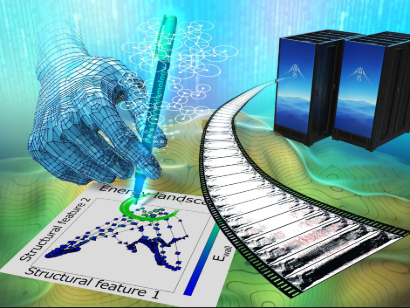
To investigate magnetisation reversal, the researchers performed large-scale micromagnetic simulations using the Fugaku supercomputer, calculating an idealised iron-based nanocrystalline soft magnet at frequencies of 100 kHz, 1 MHz, and 10 MHz. They applied persistent homology, a mathematical technique that quantifies shapes and connectivity in images, to characterize evolving magnetic domain-wall networks. Principal component analysis compressed the resulting image-based descriptors into a two-dimensional representation. They then linked this representation to an image-derived exchange-energy measure and constructed an energy landscape with inverse mapping to identify the structures contributing most strongly to the energy barrier.
The analysis showed that magnetic domains became increasingly subdivided as excitation frequency increased. They identified an energy barrier near the coercive region, where magnetisation reverses, that increased with frequency. Most importantly, inverse mapping revealed that high-contribution features were concentrated around propagating reversed-domain tips and selected fine wall segments, rather than being distributed uniformly across the network. This finding suggests that similar walls can play different roles during reversal. The identified barrier represents an exchange-derived structural energy cost, not a direct measurement of dissipated heat.
These findings offer a new way to investigate the microscopic structures associated with energy loss in magnetic materials. They could eventually guide the development of low-loss magnetic materials for electric vehicles and power-conversion equipment used in data centres. Understanding structures linked to greater resistance could help researchers investigate how material composition and processing influence domain-wall behavior.
“Our study could contribute to energy conservation and CO₂ emission reduction through improved power conversion efficiency and reduced heat generation” added Professor Kotsugi.
By integrating supercomputing, topology, magnetic physics, and explainable AI, this study connects complex magnetic structures with their contributions to energy barriers. While establishing a promising framework for investigating microscopic sources of energy loss and developing more efficient power electronics.
For additional information: