
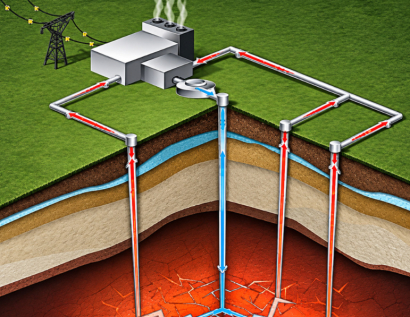
Lehigh has received $1.6 million to participate in the “Commonwealth of Pennsylvania EGS Pilot Demonstration,” a U.S. Department of Energy-funded project led by the Pennsylvania Department of Environmental Protection. The total project budget is about $14 million. The “EGS” stands for enhanced geothermal system.
“This project shows what’s possible when faculty work across disciplinary and college boundaries,” said Robert Flowers, Herbert J. and Ann L. Siegel Dean of the College of Arts and Sciences. “Earth scientists from the College of Arts and Sciences and engineers from the P.C. Rossin College of Engineering and Applied Science are bringing complementary expertise to a problem neither could solve alone. Research like this matters because discoveries don't stay in the lab. It’s designed to bring new possibilities to Pennsylvania communities, and it reflects Lehigh’s commitment to scholarship that serves the people and places around us.”
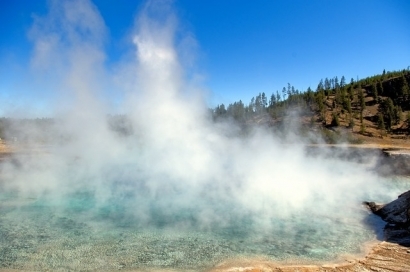
The goal is to generate one megawatt of electricity from a low-enthalpy, underperforming Marcellus Shale gas well in Indiana County, Pennsylvania. The project will draw heat from an underperforming natural gas well by circulating water at depth, and then bring that heated water to the surface. That heated water energy will produce electricity for the local grid and supply direct-use heat to nearby homes and businesses.
“Pennsylvania’s conventional hydrocarbon industry, followed by the shale oil and gas revolution left behind a vast network of wells and related infrastructure ,” said Frank Pazzaglia, professor of Earth and environmental sciences in Lehigh’s College of Arts and Sciences and the principal investigator. “This project asks whether we can give that infrastructure a second life as a clean, renewable energy source.”
The pilot will use a deep existing unconventional gas well in Indiana County, PA where the geology is favorable for tapping geothermal resources. The well is operated by CNX Green Ventures, an Appalachian oil and gas producer.
“Repurposing abandoned hydrocarbon wells for low-enthalpy geothermal mining represents an economic and environmental opportunity, transforming the methane-leaking liability into a predictable source of clean, local energy,” said Carlos Romero, professor of mechanical engineering and mechanics in the Rossin College and director of Lehigh’s Energy Research Center.
Project leaders say the approach could also create opportunities for displaced oil, gas, and coal workers, whose subsurface experience transfers directly to the geothermal industry. By extending the useful life of existing wells, the project aims to stimulate geothermal energy development, particularly in the eastern US where geothermal resources are more restricted than in the western US, and demonstrate that the approach is portable.
“The project is a chance to train the next generation of scientists and engineers while helping to show that geothermal energy can work in places many people wouldn’t expect,” Pazzaglia said.
Lehigh’s funding will support five researchers and students from two units. The Department of Earth and Environmental Sciences (EES) will include three principal investigators, a postdoctoral researcher and a graduate student, while the Energy Research Center will include two principal investigators and a graduate student. Project personnel from Lehigh include Frank Pazzaglia; Steve Peters, associate professor of EES; Anne Meltzer, professor of EES; Carlos Romero and Muhannad Suleiman, professor of civil and environmental engineering.
DEP is the project lead, working in coordination with the Pennsylvania Geological Survey. Partners include Gradient Geothermal Inc., Teverra Inc., Idaho National Laboratory, CNX Green Ventures, and Seequent, in addition to Lehigh University.