
This bill is one of 12 solution-oriented energy bills PEC either authored, informed or advocated for in the General Assembly that have been signed into law. PEC worked on these practical legislative proposals with partners before the 2026 General Assembly session, laying the groundwork for accelerating underutilized small-scale, distributed generation and storage opportunities in Virginia. These bills contribute to the Commonwealth’s clean energy future while also enabling energy independence for more Virginians.
“The topic of agrivoltaics is one that has been top of mind for me for years,” said Spanberger, “because it has always been a question of how is it that we can ensure that our communities–and importantly our farmers–have the ability to keep land in production, but also the option to leverage the technology that can help them offset their on-farm costs and also allow them to be leaders.
"By establishing clear enforceable definitions of agrivoltaics and code of Virginia, we are protecting farmers. We are making clear that the use of agrivoltaics prioritizes agricultural productivity, keeps land in production for the life of the solar array and is part of an existing farm business.”
Until now, Virginia has lacked an official definition for agrivoltaics. This is critical, not only to build policy and incentive structures for such projects, but also to avoid poorly developed agrivoltaics – which can undermine the future of this promising approach. Working alongside the Virginia Farm Bureau, PEC helped develop an official definition for agrivoltaics that will ensure dual use solar projects take best management practices into account. This bill, which garnered strong bipartisan support and was a priority bill for the Governor, defines agrivoltaics to mean:
“…the intentional co-location of agricultural production and solar energy generation on the same land that:
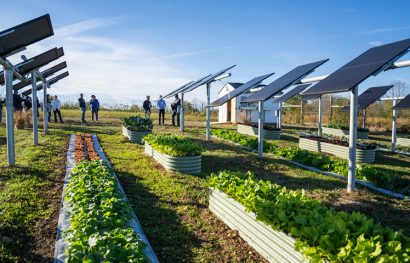
PEC’s Community Farm demonstrates a real-world example. It also has full battery backup, which allows the farm to run fully on solar and battery in case the electricity grid goes down. When multiple farms, businesses and homes use battery backup, the energy they produce and store together can function as a “virtual power plant,” furthering the potential for decentralized power generation, mitigating new transmission and generation impacts, and compensating those owners for their contributions to the power grid.
“We’re proud to convene this bill signing at the site of the first crop-based agrivoltaics project in Virginia,” said PEC Senior Energy & Climate Advisor Ashish Kapoor. “Behind me, you can see kale, lettuce, beets, broccoli, garlic and more, growing under solar panels that are generating energy to reduce this farm’s electricity bill.
"In fact, we have had no electric bill this year. This site provides a model for other farms in Virginia, and we hope farmers who want to achieve more energy independence will consider integrating solar energy production into their crop production. Virginia has 39,000 farms. If ten percent of those farms installed an agrivoltaics project that produced just 1 megawatt of power on a few acres, we could produce the equivalent power of four nuclear power plants.”
The agrivoltaics definition bill also provides a critical foundation for a future stakeholder group that will develop potential incentives to advance agrivoltaics in the Commonwealth. In addition, the definition can guide regulation of agrivoltaics in other solar policies.