

The declaration came in response to calls from world leaders to ensure the Antalya summit is remembered as ‘the Implementation COP.
The Global Wind Declaration for Powering the Future, an initiative of the Global Wind Energy Council (GWEC) in partnership with the Turkish Wind Energy Association (TUREB), delivers a blueprint for scaling wind power over the next decade. The declaration comprises a set of industry commitments together with government recommendations to help create the conditions for new investments.
“The transition to a clean, secure and affordable energy system begins with wind power” said Ben Backwell, CEO of GWEC. “By putting wind power at the centre of energy system planning, we can meet rising demand for clean, homegrown and affordable energy in an electrified economy. We can help countries meet their climate targets, power economic growth and protect families, communities and businesses against future energy shocks. This means getting serious about fast-tracking new wind power projects. If it takes two years to build an offshore wind farm, for example, it should not take eight to 12 years to get the necessary permits. With the Global Wind Declaration for Powering the Future, we set out a pathway to triple or even quadruple wind power capacity over the next decade. But delivering on global and national targets – and accelerating wind at the pace demanded by governments – can only happen if the public and private sectors work together. This requires predictable policy and clearer demand signals, better integrating wind in the power system and working to address challenges across grids, permitting, finance and supply chains.”
At the COP31 Leaders’ Summit, United Nations Secretary-General António Guterres warned the world is moving “far too slowly” in addressing climate change, as he urged a tripling of renewable energy capacity by 2035, based on 2025 levels.
“We need an extraordinary acceleration” the Secretary-General said, “expanding renewables, grids, storage and clean electrification at bullet speed.”
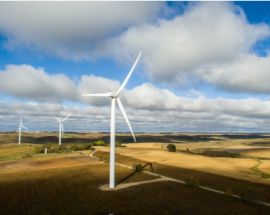
Recognised as a proven, low-cost and reliable source of clean electricity generation, wind energy is currently powering nearly 140 countries. Global installed wind capacity has grown more than twenty-fold in the past two decades, reaching 1,299 GW by the end of 2025, according to GWEC. The sector commissioned 165 GW of new capacity last year, up 40 percent on the previous record-breaking year, with the amount of new capacity added in 2025 alone enough to power another 118 million households.
The Global Wind Declaration for Powering the Future includes modelling from GWEC showing that the wind power sector is currently on a pathway to reach 2 Terawatts (TW) by 2029 and hit 3 TW by 2035. With stronger support from governments to remove barriers faced by developers and manufacturers, help de-risk projects and mobilise investment, global wind capacity could climb even further, potentially even reaching 4 TW by 2035 according to the declaration.
The Global Wind Declaration for Powering the Future was launched by GWEC in partnership with TÜREB with the backing of leading wind power developers, manufacturing and companies from across the supply chain, as well as the support of regional and national wind industry associations from across Europe, Africa, the Americas, Asia and the Pacific.
Five Guiding Principles for Accelerated Development are outlined in the declaration, comprising both commitments by industry as well as recommendations for governments. These cover:
Delivering Policy Certainty and Investable Pipelines to Scale Deployment
Building Wind Industries That Anchor Regional Economies
Driving Innovation, Standards and Sustainable Supply Chains
Better Integrating Wind in Energy System Planning
Unlocking the Full Potential of Offshore Wind
“When you look at how far wind has come, there is a lot to celebrate” added Michael Hannibal, Chair of GWEC, a Partner at Copenhagen Infrastructure Partners and Chief Commercial Officer at Stiesdal Offshore. “We have built an industry that today delivers almost 1.3 TW of capacity worldwide, and last year alone we added a record 165 GW. But for me, the most exciting part is what comes next: the opportunity to grow global wind capacity to over 4 TW by 2035. We have shown that we can build at scale. Now we need to go faster, mobilise even more investment and turn that ambition into projects.”
For additional information: