
Published at a time of rising instability and uncertainty in international energy markets, GWEC’s 2026 Global Offshore Wind Report sets out an eight-point action plan for policymakers to ensure that offshore wind projects are prioritized for investment as nationally significant projects in planning and procurement frameworks.
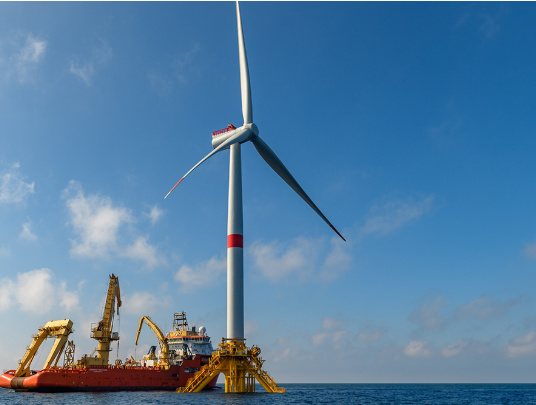
In 2025, more than 9 GW of new offshore wind capacity was grid-connected worldwide, enough to power over 10 million homes according to GWEC. This made 2025 the third-highest year for new installations, bringing the cumulative total installed worldwide to 92.5 GW, equivalent to powering over 100 million homes.
With more than 50 GW of offshore wind projects in construction around the world, annual installations are expected to double in 2026, triple by 2031, and surpass 50 GW per year by 2035.
Predicted to reach a compound average annual growth rate of 24% between 2026 and 2030, offshore wind is set to become one of the world’s fastest-growing mainstream energy technologies. More than 327 GW of new offshore wind capacity is forecast by GWEC to be added in the next decade, taking global offshore wind capacity to 420 GW by the end of 2035.
“We expect to see exceptional growth over the next decade leading to a quadrupling of the world’s offshore wind capacity. Built at scale, offshore wind is a unique strategic asset and one of the best available utility-scale renewable power sources for a clean and secure power system offering high, predictable electricity generation,” said Rebecca Williams, Deputy CEO of GWEC.
Williams continued, “In less than five years we have faced two major crises caused by continued reliance on imported fuels. It’s now abundantly clear that we’re in a race to electrify our economies and deploy as much reliable, homegrown renewable energy as possible before the next crisis erupts. Building an arc of offshore wind turbines along a country’s coast is a way to guard against future supply shocks.”
The 2026 Global Offshore Wind Report is published at a time when a growing number of markets including the UK, European Union, Türkiye, China, the Philippines, Vietnam, South Korea and Japan have demonstrated their intent to move further and faster to strengthen their energy resilience.
The report shows that diversifying energy systems is more than a climate objective, it is a fundamental pillar of national energy security and industrial growth. In addition, the report explores emerging trends and identifies solutions to long-standing issues such as delayed auctions, grid bottlenecks, permitting backlogs and constrained supply chains, which all slow development and help to deter vital investment.
Looking back at 2025, the report shows the global offshore market grew on average by 10% each year over the past decade, and the 92.5 GW installed to-date accounted for 7.1% of total global wind capacity. China led annual installations for the eighth consecutive year, commissioning 6.6 GW in 2025, while Europe commissioned nearly 2 GW across three markets: the UK (1.0 GW), Germany (0.5 GW) and France (0.4 GW).
Despite this progress, offshore wind deployment is not proceeding as fast as it should. The amount of offshore wind procured in auctions during 2025 was, at 11.4 GW, just one fifth of the record set in 2024. Additionally, around 25 GW of projects worldwide outside of China are still awaiting financial investment decision (FID) and are classed by GWEC as ‘ready to build’ having received consent and planning permission; these projects may be waiting for grid connections, auction outcomes or subsidy arrangements before they are green-lit.
To help accelerate the global deployment of offshore wind, GWEC is calling on governments to prioritize the following actions: